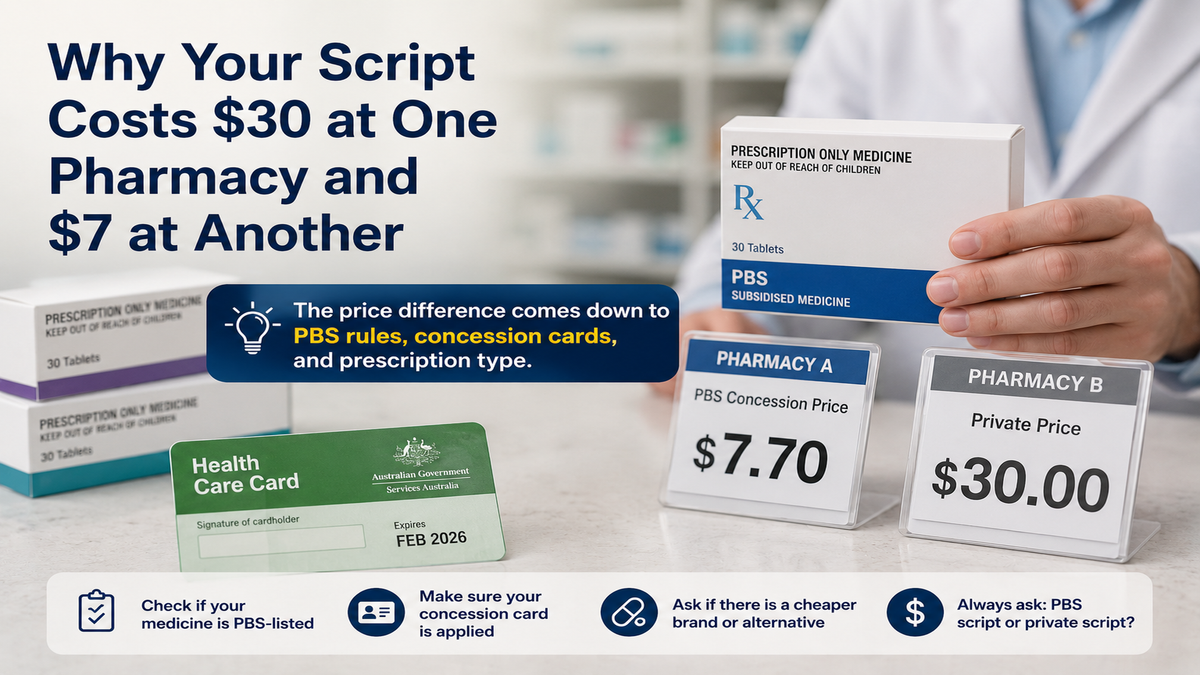
Why Your Script Costs $30 at One Pharmacy and $7 at Another
Why your prescription can cost $30 at one pharmacy and $7.70 at another. Learn how PBS rules, concession cards, private scripts, brand premiums and the Safety Net affect medicine prices.

You don’t usually question the price of a prescription until it looks wrong.
You hand over the script, tap your card, and only later realise the same medicine was much cheaper last time. Or you ask the price before paying and hear a number that makes you pause. Same medicine, same-looking box, but somehow not the same cost.
That moment is frustrating because it feels like the pharmacy price is random. Most of the time, it isn’t. The price usually depends on what kind of script it is: PBS or private, general or concessional, brand-name or generic, authority-approved or not, above or below the PBS co-payment.
That’s the part people don’t see. The medicine on the shelf might look identical, but the pricing rule behind it can be completely different.
This guide explains why one prescription might cost $7.70, another might sit around $25, and another might be much higher and what to ask before you pay more than you expected.
Short answer first
In 2026, the maximum PBS co-payment for general patients is $25 per PBS prescription. If you have an eligible Commonwealth concession card, the concessional PBS co-payment is $7.70, and it's frozen at that level until 2030. Those figures apply to PBS medicines when the prescription meets the PBS rules.
But not every prescription is charged as a PBS prescription. A script can cost more if it's private, if the medicine isn't PBS-listed for your condition, if the quantity or directions don't fit PBS rules, or if you choose a brand with a premium attached. A script can also cost less than the PBS co-payment if the medicine is priced below the maximum, or if a pharmacy applies an allowed discount.
That's why the same medication can feel completely different at the counter depending on where you fill it. Before anything else, it's worth asking whether the script is actually being charged as PBS or as private that one question clears up more confusion than almost anything else.
PBS pricing is not the same as pharmacy pricing
The Pharmaceutical Benefits Scheme, or PBS, is the Australian Government program that subsidises many prescription medicines. If a medicine is listed on the PBS and your prescription meets the rules, the government pays part of the cost and you pay a co-payment. That co-payment is the maximum amount you pay for that PBS item before any premiums or special charges. In 2026, the maximum general PBS co-payment is $25, while eligible concession card holders pay up to $7.70. The current co-payment rules are explained on the Department of Health's PBS co-payments page.
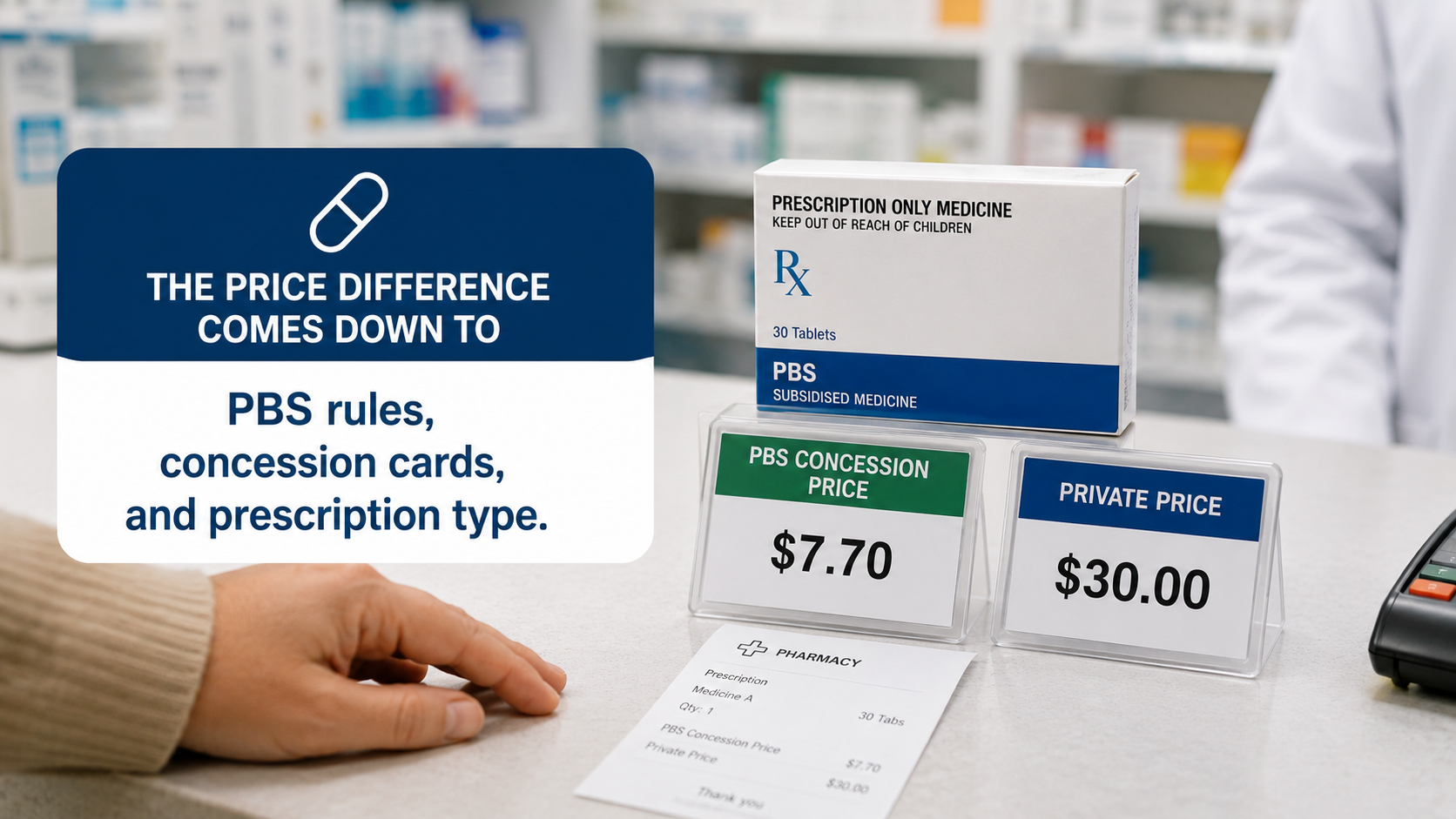
The trouble is that people tend to use the word "script" for everything. A PBS script, a private script, a below-co-payment script and a brand-name script can all look identical when the doctor hands them over, but they get priced very differently once you're standing at the counter. So when someone tells me "my script was $30," the first question isn't which pharmacy they went to. It's whether it was actually PBS-subsidised in the first place.
Why one script might be $7.70
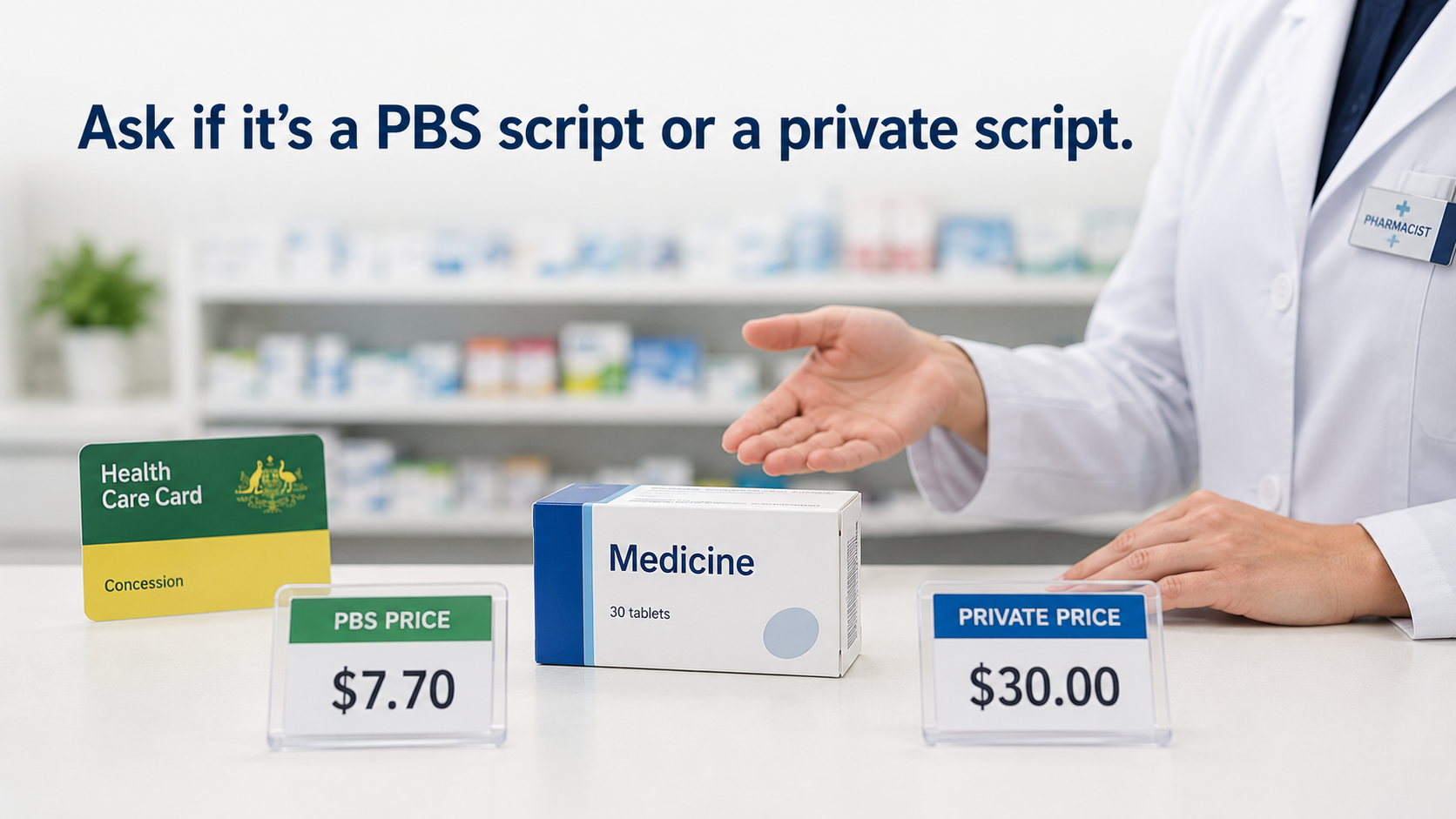
A script that costs $7.70 usually means the concessional PBS co-payment has been applied. This can happen if you hold an eligible concession card a Health Care Card, Pensioner Concession Card, Commonwealth Seniors Health Card, or certain DVA cards.
The card itself matters, and so does the paperwork around it. It needs to be current, and the pharmacy needs to have the correct details on file. If your concession card has expired, changed, or simply hasn't been added to your pharmacy profile, you'll likely be charged the general PBS price instead even if you're entitled to the lower one.
The $7.70 figure only applies when the medicine is being supplied under the PBS in the first place. If the prescription is private, or if the doctor has prescribed the medicine in a way that doesn't meet the PBS listing rules, having a concession card won't bring the price down to $7.70. This is exactly where people get caught out they assume the card guarantees a low price on everything, when really it's a PBS price, not a blanket pharmacy discount.
Two questions are worth keeping in your back pocket here: is your concession card actually attached to this prescription, and if the price still looks high, is the medicine PBS-listed for the way it's been prescribed?
Why one script might be around $25 or more
In 2026, if you're a general patient with a Medicare card and the medicine is supplied under the PBS, the maximum co-payment is $25. If a PBS script comes in above that, there's usually a brand premium or therapeutic group premium involved somewhere.
Other times the real answer is that the script simply isn't PBS at all. A private prescription is priced differently the pharmacy can charge whatever the market will bear, and that price varies a lot between pharmacies. This is why the same script can be $30 at one place and $45 at another, or considerably less somewhere else entirely. The PBS caps what you pay for PBS prescriptions, but it doesn't standardise every prescription in the country.
There's also the opposite case: some medicines cost less than the PBS co-payment threshold to begin with, so you end up paying the lower, actual price rather than the capped one. None of this means a higher price is automatically wrong it just means you need to know which pricing bucket your script has landed in.
PBS-listed doesn't always mean PBS-priced for you
This is probably the most confusing part of the whole system. A medicine being listed on the PBS doesn't automatically mean every prescription for it is subsidised. PBS listings often come with restrictions a medicine might only be subsidised for certain diagnoses, patient groups, doses, or treatment steps, or it might require an authority approval before the prescriber can issue it under PBS at all.
A medicine can be PBS-listed for one condition but not another. It might need an authority prescription, where the prescriber has to confirm the PBS criteria are actually met. If those conditions aren't satisfied, the pharmacy has no choice but to dispense it privately even though the exact same box sits on the same shelf either way. The subsidy follows the listing and the prescription conditions, not the physical medicine itself, and that's genuinely counterintuitive the first time you run into it.
If a price seems much higher than you expected, it's worth asking the pharmacist whether there's a PBS restriction attached to the medicine, or asking the prescriber directly whether it can be written up under PBS for your condition. This comes up a lot with newer medicines, specialist treatments and long-term prescriptions.
Brand choice can change the price
Even when a medicine is PBS-subsidised, the brand you walk out with can change what you pay. Some PBS medicines are available under more than one brand, and if the brand you choose carries a premium, that premium gets added on top of your usual co-payment. Therapeutic group premiums work similarly when a medicine sits in a group of drugs considered to have comparable health outcomes, the government subsidises up to the price of the cheapest one in that group. Choose something pricier within the group and you cover the difference yourself. The Department publishes the current brand premium list on the PBS Brand Premium page, with therapeutic group premiums on a separate page.
One detail that catches people off guard: premiums don't count toward the PBS Safety Net the same way ordinary co-payments do. So paying extra for a premium brand can cost you more without actually moving you any closer to the Safety Net threshold.
Sometimes the cheaper brand works perfectly well. Other times a prescriber has clinical reasons for not wanting substitution. Either way, it's a fair question to ask at the counter is there a cheaper equivalent, and has the doctor allowed substitution?
The pharmacy itself can matter too
For PBS medicines, the maximum co-payment is set nationally, but pharmacies still have some room to move. In 2026, the allowable discount for general patients has been reduced to nil, while pharmacies serving concession card holders can still discount the concessional co-payment by up to 60 cents if they choose to. So a concession PBS script might run $7.70 at one pharmacy and $7.10 at another that's not an error, it's just an allowed discount some pharmacies pass on and others don't bother with.
Private prescriptions are a different story again. Pricing can vary much more widely there, and online pharmacies or large discount chains sometimes price non-PBS medicines quite differently from a smaller community pharmacy. Before comparing prices anywhere, it's worth double-checking you're actually comparing the same thing same medicine, same strength, same quantity, same brand, and PBS versus private.
60-day scripts change the picture too
Since the staged rollout began in September 2023, hundreds of PBS medicines have become available as 60-day prescriptions for people on stable, ongoing treatment. In practice that can mean buying two months' worth of medicine for the price of a single PBS co-payment instead of paying $25 twice, you pay it once.
If you're on a regular medicine for a stable condition, it's worth raising with your doctor whether it qualifies for a 60-day script. Not every medicine or condition does, but where it applies, the saving adds up meaningfully across a year. The Department of Health keeps the current eligible list on its cheaper medicines page.
The PBS Safety Net changes the price later in the year
The PBS Safety Net tracks your eligible PBS spending across a calendar year. Once you or your family cross the threshold, your PBS costs drop for whatever's left of that year.
In 2026, those thresholds sit at $1,748.20 for general patients and $277.20 for concession card holders. Once you've reached it, general patients typically move to the concessional co-payment rate for the rest of the year, and concession card holders often pay nothing at all for eligible PBS medicines — though premiums and certain extra charges can still apply on top. Current thresholds are published on the Services Australia PBS Safety Net page.
If different family members are filling scripts at different pharmacies, that spending doesn't always get tracked together automatically. It's worth asking your pharmacist how close you are to the threshold, and if you're spreading scripts across multiple pharmacies, keeping your own running total means nothing gets missed.
Putting it into practice
All of this matters most if you're on regular medication. A small monthly difference in co-payment compounds into real money across a year, and making sure your concession card is active and properly linked at your usual pharmacy stops you paying the general rate by mistake. If you're a general patient, just knowing the 2026 cap sits at $25 helps you notice when a price isn't behaving the way a normal PBS script should.
It comes up even more when a specialist prescribes something new. Specialist scripts are more likely to involve authority rules, brand decisions, or genuinely higher private costs, so if the first price shocks you, it's worth pausing before you pay and working out whether the script is PBS, private, authority-approved, or tied to a particular brand.
The more useful question, in almost every case, isn't "why is this pharmacy expensive?" it's "what pricing rule is actually being applied here?"
A few traps worth knowing about
The most common one is assuming a concession card drops every medicine to $7.70. It only works that way for PBS prescriptions that meet the rules — private scripts and non-PBS medicines can still cost you the full amount regardless of the card in your wallet. Close behind that is assuming PBS-listed automatically means PBS-priced for you specifically, when a medicine can sit on the PBS schedule and still not be subsidised for your particular diagnosis, dose or prescribing pathway.
Brand premiums trip people up in a similar way choosing a premium brand over an available cheaper equivalent means paying extra that won't even count toward your Safety Net. And plenty of people simply forget the Safety Net exists until well into the year, by which point they've missed months of tracking that could have brought the threshold closer. Finally, when comparing prices between pharmacies, make sure the details actually match: thirty tablets of one brand isn't the same quote as sixty of another, and a private price was never going to look like a PBS co-payment.
How to check, in practice
Start at the pharmacy counter. If a price surprises you, ask before you pay it's far easier to sort out while the pharmacist still has the script open in front of them.
A few questions tend to cut through most of the confusion: is this being charged as a PBS script or a private one? Has my Medicare or concession card actually been applied? Is there a PBS restriction or authority requirement on this particular medicine? Is there a cheaper equivalent brand, and has the doctor allowed substitution? Does this brand carry a premium? And will this amount count toward my PBS Safety Net?
If the pharmacist tells you the script is private because of how it's written, that's worth taking back to the prescriber ask whether the medicine can be prescribed under PBS for your condition, or whether it needs an authority approval first. And if you're comparing prices between pharmacies, jot down the medicine name, strength, quantity, brand, and whether it's PBS or private before you start without those details, two prices can look wildly different simply because they were never the same supply to begin with.
Where this leaves you
A script can run $30 at one pharmacy and $7.70 at another because the pricing rules genuinely differ from case to case. The same medicine might be PBS-subsidised for one person and private for someone else. A concession card might be correctly applied in one instance and missing in the next. A brand premium, a private price, your Safety Net status, or a 60-day prescription can all shift the final number in ways that have nothing to do with which pharmacy you happened to walk into.
The habit that actually helps is asking what pricing rule is in play before you hand over your card PBS, private, concessional, premium brand, or below co-payment. Once you know which one you're dealing with, the price at the counter usually stops feeling random.
PBS rules and thresholds get reviewed regularly, so it's worth checking the official PBS and Services Australia pages directly rather than going on a figure you remember from last time you filled a script.
Sources
Department of Health — PBS co-payments
PBS — About the PBS
PBS — Information for pharmacists
PBS — Brand Premium
PBS — Therapeutic Group Premium
Services Australia — PBS Safety Net thresholds
Department of Health — 60-day prescriptions