Building vs Buying an Existing Home in Australia: Which Grants Apply
Building vs buying an existing home in Australia? See which first home buyer grants, stamp duty concessions, and deposit schemes may apply to new builds or established homes.

If you've ever searched "first home buyer grant Australia" and ended up more confused than when you started, you're not alone. One page says first home buyers can get a grant, another says the grant is only for new homes, and then a lender starts talking about the Home Guarantee Scheme as if it's the same thing.
I had the same confusion when I first tried to figure out why my mate got $30,000 and I got nothing. The answer comes down to one thing most people miss: it's not just about being a first home buyer. It's also about what type of home you're buying.
Short answer first
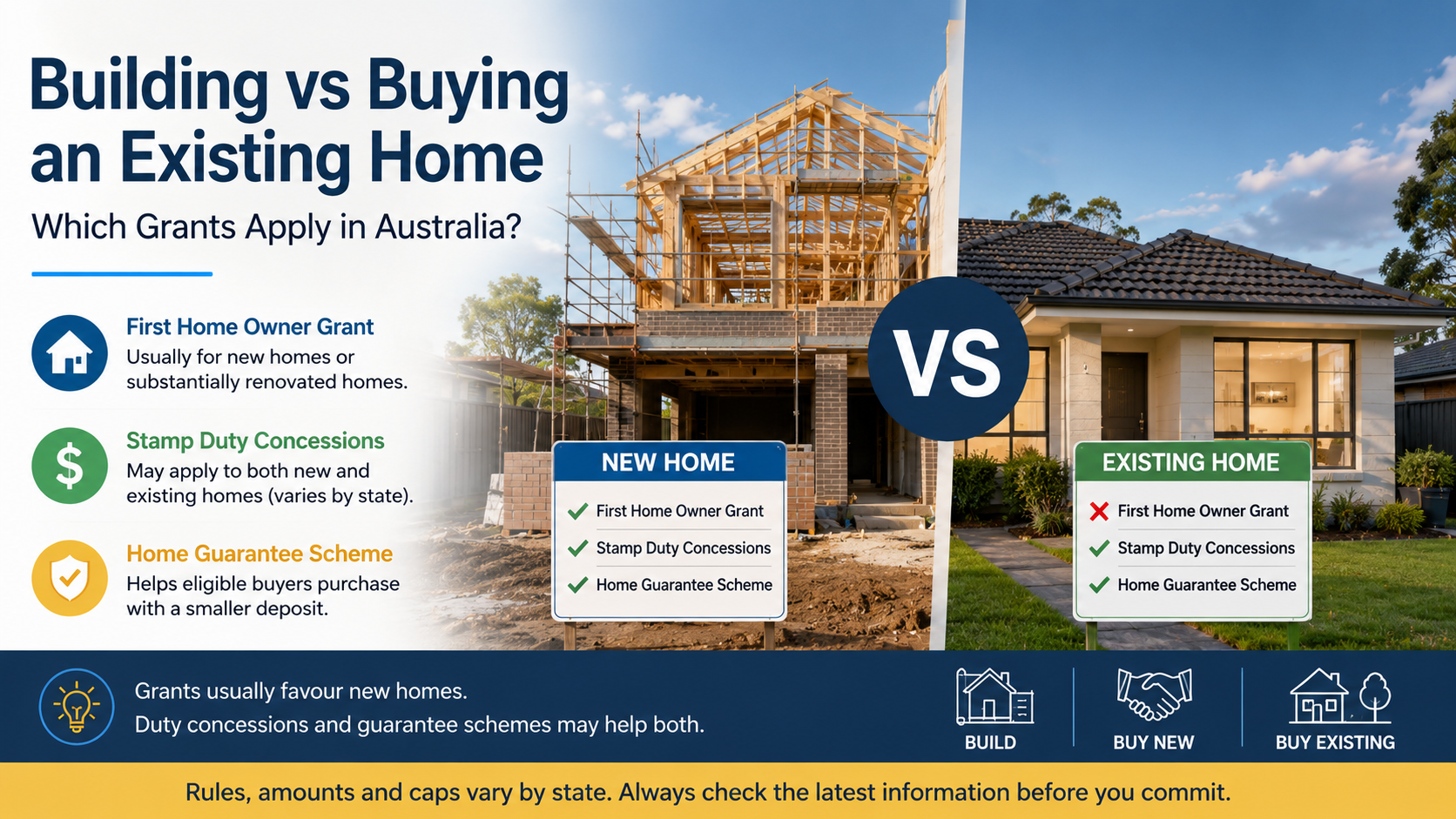
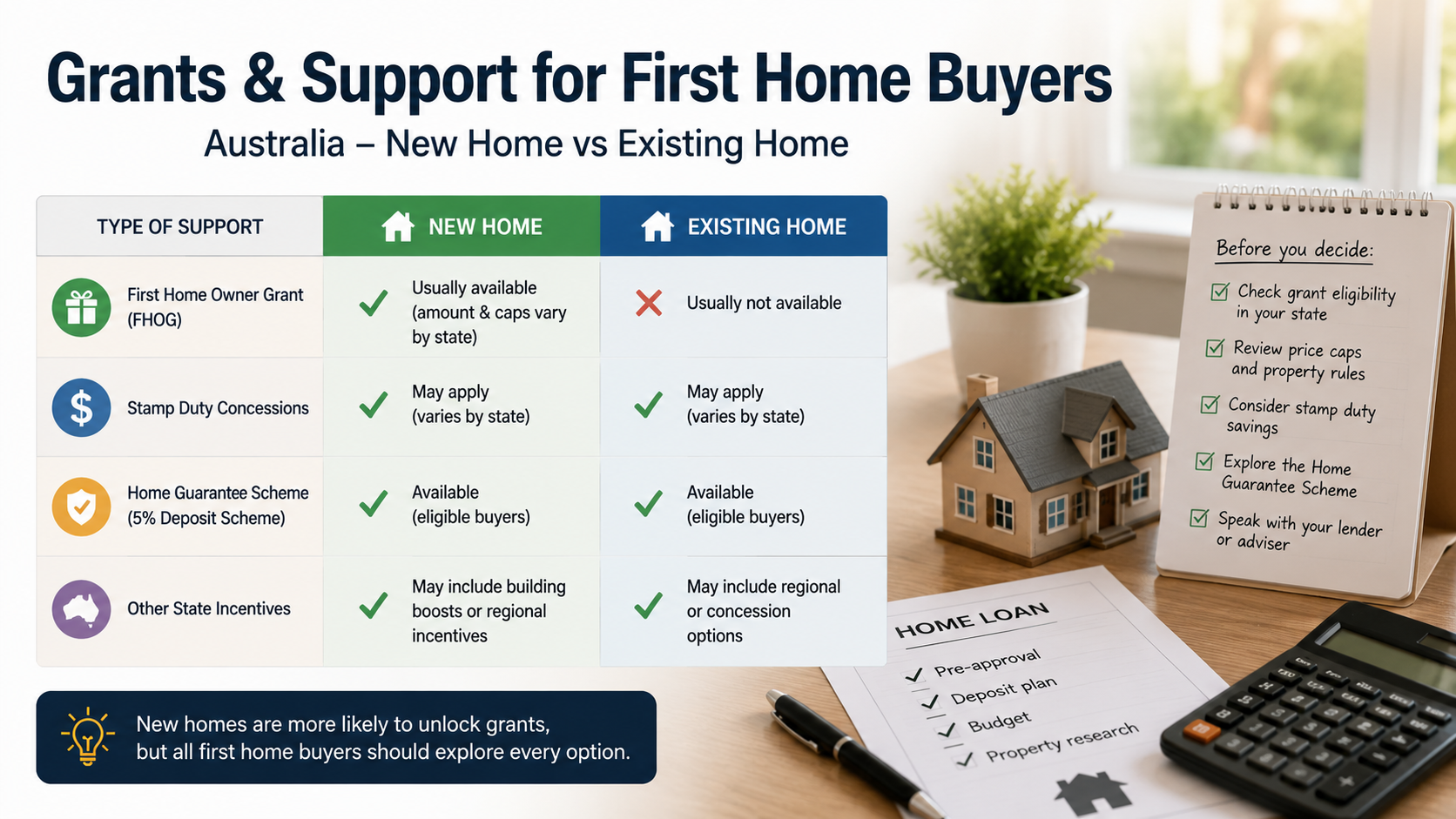
In most states, the First Home Owner Grant only applies to new homes — not established ones. That means building a home, buying a brand-new home that hasn't been lived in, or in some cases a substantially renovated home. If you buy an existing home, the grant usually won't apply.
But that doesn't mean there's no help. The amounts and caps vary significantly by state: Queensland offers a $30,000 First Home Owner Grant for eligible new homes under $750,000, with the increased amount continuing from 1 July 2026 under current Queensland Government information. NSW pays $10,000 for new homes under $600,000 (or $750,000 if building), and WA has a $10,000 grant for new homes, with the cap for homes south of the 26th parallel increased to $800,000 from 7 May 2026. Existing-home buyers may still qualify for stamp duty concessions or the Home Guarantee Scheme, depending on their situation and location.
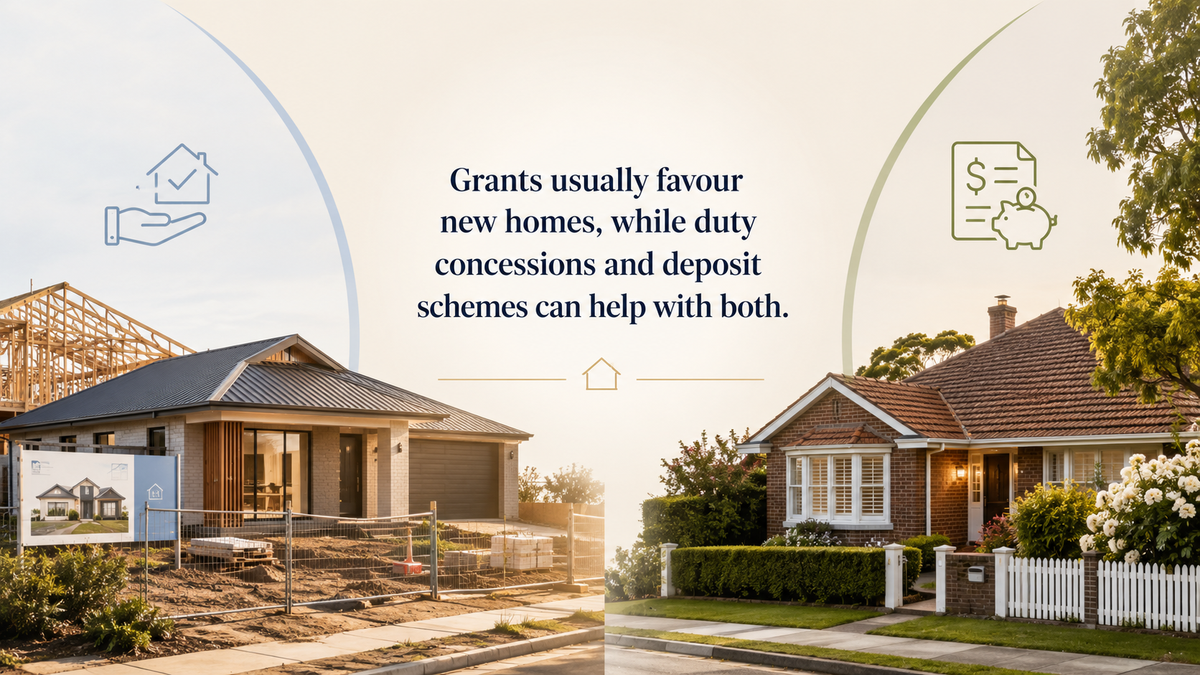
The easiest way to think about it: grants usually favour new homes, while duty concessions and deposit schemes are more likely to help with both new and existing homes.
The name makes it sound simpler than it is
"First Home Owner Grant" sounds like a payment for anyone buying their first home. That's where people get caught.
In most states, the grant isn't just about being a first home buyer. It's also about what type of home you're buying. A newly built house, an off-the-plan apartment, a house-and-land package, or a home you're building on vacant land may be treated very differently from a 30-year-old established home.
NSW, for example, says its $10,000 First Home Owner Grant is available when you buy or build your first new home but it's not available for established homes. The full rules are on the Revenue NSW First Home Owner Grant page. Victoria has a similar structure: the $10,000 grant is for newly constructed homes that have never been occupied, with current rules on the State Revenue Office First Home Owner Grant page.
So the first question isn't just "Am I a first home buyer?" It's also "Is this home new enough to qualify?"
Building a new home
Building is the option most closely linked to the First Home Owner Grant. If you buy vacant land and sign a building contract or enter a house-and-land package you're likely looking at exactly the type of transaction state revenue offices have in mind.
The details vary by state. In NSW, Revenue NSW looks at the combined value of the land, building contract, and any variations against the $750,000 threshold. In Queensland, the grant is $30,000 for eligible new homes under $750,000, with the increased amount continuing from 1 July 2026 under current Queensland Government information. For owner-builders in Queensland, the grant applies where foundations are laid from 20 November 2023 onward check the current QRO page for the applicable dates. South Australia is another useful example: RevenueSA says eligible transactions include buying land and a new home under a comprehensive building contract, or building on vacant land you already own. Current South Australian rules are on the RevenueSA first home buyer page.
Building also affects timing. Some schemes look at when the contract is signed, when construction starts, when the home is completed, or when you move in. That matters because a grant may not be paid at settlement and if you're counting on it for a first progress payment, the timing matters as much as the amount. This is one reason to check with your lender early.
Buying a brand-new home or off-the-plan property
Buying a completed new home can be simpler than building because there's usually one contract and one settlement date. But the "new" part still has to be real.
A home is generally treated as new if it hasn't been previously occupied or sold as a place of residence. A substantially renovated home may qualify in some states, but the rules are stricter than people expect it's not enough that the kitchen looks new or the bathroom was updated before sale.
NSW treats newly built, off-the-plan, and substantially renovated homes as possible First Home Owner Grant properties, while WA says its grant applies to new residential dwellings and substantially renovated homes. You can check the WA rules on the RevenueWA First Home Owner Grant page. Tasmania has a $30,000 grant for eligible transactions between 1 July 2025 and 30 June 2026 for new homes. The NT replaced its previous $10,000 grant with a $50,000 HomeGrown Territory Grant for building or buying new, with no price cap.
A useful question to ask before signing: "Has this property ever been occupied or sold as a place of residence?" If the answer is yes, it's established and the grant likely won't apply.
Buying an existing home
This is the part many first home buyers misunderstand.
If you're buying an existing home, you generally shouldn't build your plan around receiving the First Home Owner Grant. In most states, the grant is for new homes only. An established house, older apartment, or existing townhouse may still be a good buy but it often sits outside the grant rules.
That doesn't mean existing-home buyers get nothing. The help tends to come through a different door.
Stamp duty relief is the main one. NSW has the First Home Buyers Assistance Scheme, which can apply to new or existing homes if the property value is within the relevant threshold current thresholds are on the Revenue NSW First Home Buyers Assistance Scheme page. In WA, changes from May 2026 mean no duty on homes valued up to $600,000, with a concessional rate up to $800,000, applying to both new and established homes. Queensland also offers a first home concession on transfer duty for existing homes, even when the grant doesn't apply.
If you're buying existing, your search shouldn't stop at "First Home Owner Grant." Search for "first home buyer duty concession" in your state as a separate step.
The Home Guarantee Scheme is different
The Home Guarantee Scheme including the First Home Guarantee is not the same as the First Home Owner Grant. It doesn't put cash into your account. It's designed to help eligible buyers purchase with a smaller deposit and avoid Lenders Mortgage Insurance.
From 1 October 2025, the expanded First Home Guarantee removed income caps and raised property price caps significantly: up to $1.5 million in Sydney and $1 million in Brisbane. Critically, it applies to both new and existing homes. That makes it especially relevant for existing-home buyers who miss out on the grant. You can check the current caps on the Housing Australia First Home Guarantee page.
If you're building, there are extra timing rules you generally need to enter a building contract, start construction, and reach completion within set timeframes. Your participating lender is the right place to confirm those before you commit.
Help to Buy may also apply
Help to Buy is a federal shared equity scheme, easy to confuse with a grant or deposit support. The government contributes toward the purchase and shares in part of the property value. It can apply to newly built or existing homes at or below the price cap for the location, and to vacant land for a new build if you've signed a comprehensive building contract with an eligible builder. Details are on the Australian Government Help to Buy Scheme page.
This isn't free money. Shared equity changes how you own the home and what happens if you refinance or sell. It may suit some buyers, but it needs more careful reading than a simple grant.
So when does this actually help?
If you're comparing a new house-and-land package with an older place in the same suburb, the difference can shift your budget meaningfully. A new build under the grant cap may look more expensive at first, but the grant and duty concessions can change the comparison significantly. In some states, the difference between paying full duty on an established home and receiving support for a new build can be large enough to affect your deposit and borrowing plan.
It's less useful if you want character homes, specific school zones, or established suburbs where new stock is limited. The grant won't change if the only homes under the cap are far from where you work. And in Queensland, the $750,000 cap rules out many new Brisbane apartments in which case the Home Guarantee Scheme may be worth checking, since it covers existing homes at higher price caps.
The better question isn't "build because grants apply" or "buy existing because it's easier." It's: after grants, duty concessions, loan costs, and timing risks, which option actually leaves you in the stronger position?
A few things to watch for
The first trap is assuming "first home buyer" and "First Home Owner Grant" mean the same thing. They don't. You can be a first home buyer and still miss out on the grant if the property is established.
The second is counting a grant before checking the property type. A house can be freshly painted and still be established. A renovated home may look new but still fail the substantial renovation test in your state.
Contract timing still catches people, especially when rules change around state budgets or contract dates. Queensland previously listed the increased $30,000 grant against contracts signed by 30 June 2026, but current Queensland Government information says the increased $30,000 amount continues from 1 July 2026. That's exactly why you should check the current state revenue page before signing. NSW, Tasmania and other states have their own date-specific rules for when contracts must be signed, when construction must start, and how long you need to live there. A delay in building can affect more than your move-in date.
And don't mix up grants with concessions. A grant is cash. A duty concession reduces transfer duty. The Home Guarantee Scheme helps with your deposit. Help to Buy is shared equity. They can all help, but they work differently and you can sometimes access more than one.
Finally, don't rely on a lender, builder or real estate agent as your only source. They can be helpful, but the official decision sits with the state revenue office or Housing Australia.
How to check
Start with the property type. Before you look at amounts, write down exactly what you're doing: buying established, buying newly built, buying off the plan, buying vacant land and signing a building contract, or building on land you already own. That single step will tell you which grant pages are actually relevant.
Then check your state revenue office for two separate things: the First Home Owner Grant and first home buyer duty relief. Don't assume the grant page and the duty concession page have the same rules they usually don't.
For the Home Guarantee Scheme, check the property price cap for your location and speak with a participating lender before signing. These schemes are handled through participating lenders, not directly through the state revenue office.
A few questions worth asking before you sign:
"Does this property count as new, established, off the plan, or substantially renovated for grant purposes?"
"Is there a duty concession even if the grant doesn't apply?"
"If I'm building, what dates do I need to meet for the land contract, building contract, construction start and occupancy?"
"Will the grant be available at settlement, at my first progress payment, or only after completion?"
The bottom line
Building or buying a brand-new home may qualify you for the First Home Owner Grant, with amounts ranging from $10,000 to $50,000 depending on your state and contract date. Buying an existing home won't get you the grant in most cases, but you may still access stamp duty concessions and the Home Guarantee Scheme with a 5% deposit.
Because caps, dates and rules are reviewed regularly, it's worth checking your state revenue office and the official Housing Australia website rather than relying on what applied a year or two ago.
Sources
- Housing Australia — First Home Guarantee
- First Home Buyers — Help to Buy Scheme
- Revenue NSW — First Home Owner Grant
- Revenue NSW — First Home Buyers Assistance Scheme
- State Revenue Office Victoria — First Home Owner Grant
- Queensland Revenue Office — First Home Owner Grant eligibility
- RevenueSA — First home buyer
- RevenueWA — About the First Home Owner Grant
- NT Government — Buying or building a new home
- Tasmania SRO — First Home Owner Grant guideline