You Could Be Leaving Thousands on the Table: Australia's Most Missed Family Payments
Many Australian families miss out on FTB, Child Care Subsidy and concession card discounts. Learn what to check, where money is commonly missed, and how to claim.


Priya's colleague mentioned it almost by accident, over coffee in the office kitchen. She was talking about her Family Tax Benefit payment, a modest fortnightly deposit that covered petrol and school snacks. Priya laughed and said she and her husband Marcus had not bothered with that in years. Their combined income was around $118,000, well past what she assumed was the cutoff.
Her colleague earned more than that.
That conversation sent Priya home to redo a calculation she had last run three years earlier, back when their income was lower and the numbers made more sense to check. What she found was not a fortune, but it was not nothing either. For their nine-year-old, they may still have been eligible for a reduced rate of Family Tax Benefit Part A. They had simply stopped checking because an old mental shortcut told them the household was earning too much.
This is a strangely common way to miss out. Not through ineligibility, but through an outdated assumption that never gets tested again.
The myth that quietly costs families money
The idea that Family Tax Benefit is only for very low-income households is one of the most persistent misunderstandings in the family payments system. It is not a wild guess either. A household income in the low six figures can feel far beyond anything that sounds like a government family payment, especially for parents who checked years ago and were told they would only get a small amount.
But the current income test is more layered than that.
For the 2026–27 financial year, families may get the maximum rate of FTB Part A if their adjusted taxable income is $69,131 or less. Above that, the payment does not automatically disappear. It reduces by 20 cents for each dollar over $69,131 until it reaches the base rate. Once family income goes over $123,078, a second income test can reduce the rate by 30 cents for each dollar over that amount until the payment reaches nil.
That gap between "maximum rate" and "nothing" is where families like Priya and Marcus can quietly fall out of the system. They ran the numbers once, saw a small or reduced figure, assumed that meant nothing was worth claiming, and never checked again as thresholds changed or their family circumstances shifted.
It is worth saying plainly: the maximum rate is not the point where eligibility begins. It is the ceiling. Below the lower income threshold, a family may receive the full per-child amount. Above it, the payment can step down gradually rather than switching off straight away. For some working families, "reduced rate" can still mean real money across a year.
The word "benefit" does a lot of quiet work here. It can make the payment sound like something only for families doing it very tough, when in practice the eligible range may be broader than many parents assume.
Two different tests, and a payment people forget exists
Family Tax Benefit is one payment split into two separately tested parts, which is where a lot of confusion starts. FTB Part A is paid per child. The amount can depend on your family's income, the age of each child, whether an older child meets study requirements, and the care percentage if parents are separated.
FTB Part B is different. It is a per-family payment aimed more at single parents, grandparent carers, and couple families with one main income. It has its own income test, including rules for the primary earner and, where relevant, the secondary earner.
That difference matters. A couple may be ineligible for Part B because both adults work and earn similar amounts, while still being eligible for a reduced rate of Part A. Treating the two parts as one combined test, or assuming a "no" on one means "no" on both, is one way families leave a genuine entitlement unclaimed.
It is worth being clear about one more distinction too. Child Care Subsidy, or CCS, helps reduce the cost of approved child care. It runs on its own rules and is not calculated as part of FTB. A family that is not eligible for FTB does not automatically know anything about its CCS eligibility, and the reverse is also true.
They are often managed through the same myGov and Centrelink systems, which makes it easy to assume one answer covers everything. It does not.
Reading your own numbers instead of an old memory
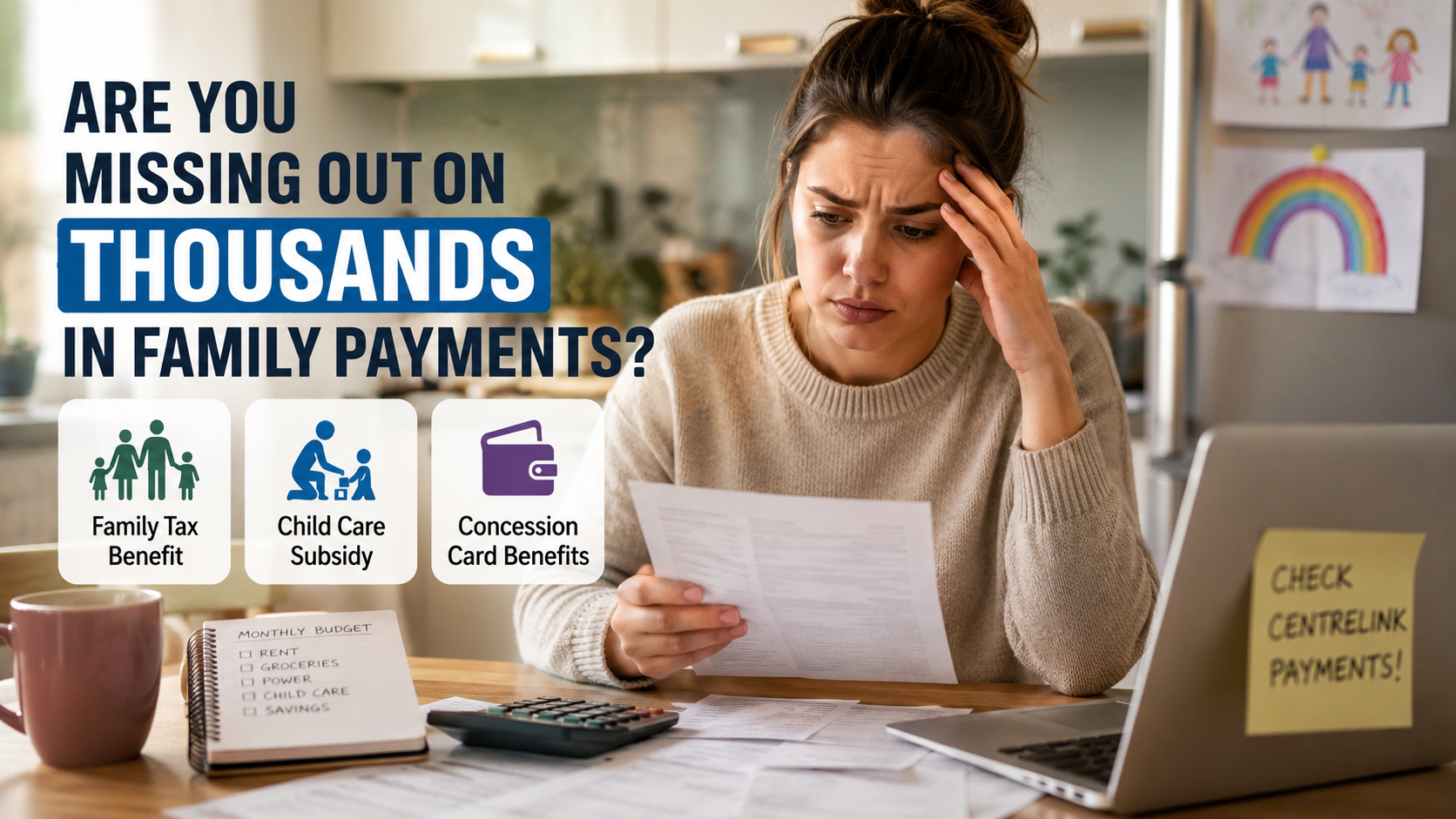
The income test looks intimidating on the page, but the mistake families make is often simple. They compare their household income with an old idea of the cutoff, rather than checking the current test.
Priya and Marcus are a good example. Their combined income placed them above the lower threshold, so they were never going to receive the maximum rate. But it did not automatically mean they were outside the system altogether, especially with more than one child and one child in a different age bracket.
The reduced amount was not life-changing. It was not going to pay the mortgage. But it was enough to cover school shoes, a few grocery shops, or the petrol money that disappears every week before anyone thinks to count it.
That is the real problem with missed FTB. It is not always a giant payment that announces itself. Sometimes it is a modest fortnightly amount, plus a possible end-of-year supplement, that adds up quietly across the financial year.
Services Australia's Payment and Service Finder and the official FTB income test pages are useful starting points for this kind of recheck. You need a current income estimate, the ages of the children in your care, and a realistic idea of your family circumstances. Running the numbers again after a pay rise, a change in work hours, or a few years of assuming the old answer still applies can be worth the effort.
What the maximum rate does not tell you
A separate trap sits inside the payment rate itself. The figures published for FTB Part A are maximum rates, meaning the highest amount possible for a child in a given age bracket before the rest of the calculation is applied.
What actually lands in a bank account depends on income, the child's age, care arrangements if parents are separated, and other family details. Two families with the same number of children can receive noticeably different amounts, and neither is necessarily doing anything wrong.
There is also a supplement that many families forget because it does not arrive fortnightly. The FTB Part A supplement is a yearly payment that may be paid after Services Australia balances your payments. For the 2026–27 financial year, it is listed as up to $970.90 for each eligible child. There is also a separate income test for the FTB Part A supplement, so a family may receive some FTB Part A during the year but still not qualify for the supplement.
That "up to" matters. It is not guaranteed for every family receiving FTB. Services Australia says the amount depends on eligibility, and the payment is worked out after balancing. Families who put off lodging tax returns, or who forget to tell Centrelink they do not need to lodge, can find this money delayed for months. It may not be lost, but delayed money does not help with this month's grocery bill.
The balancing step people skip
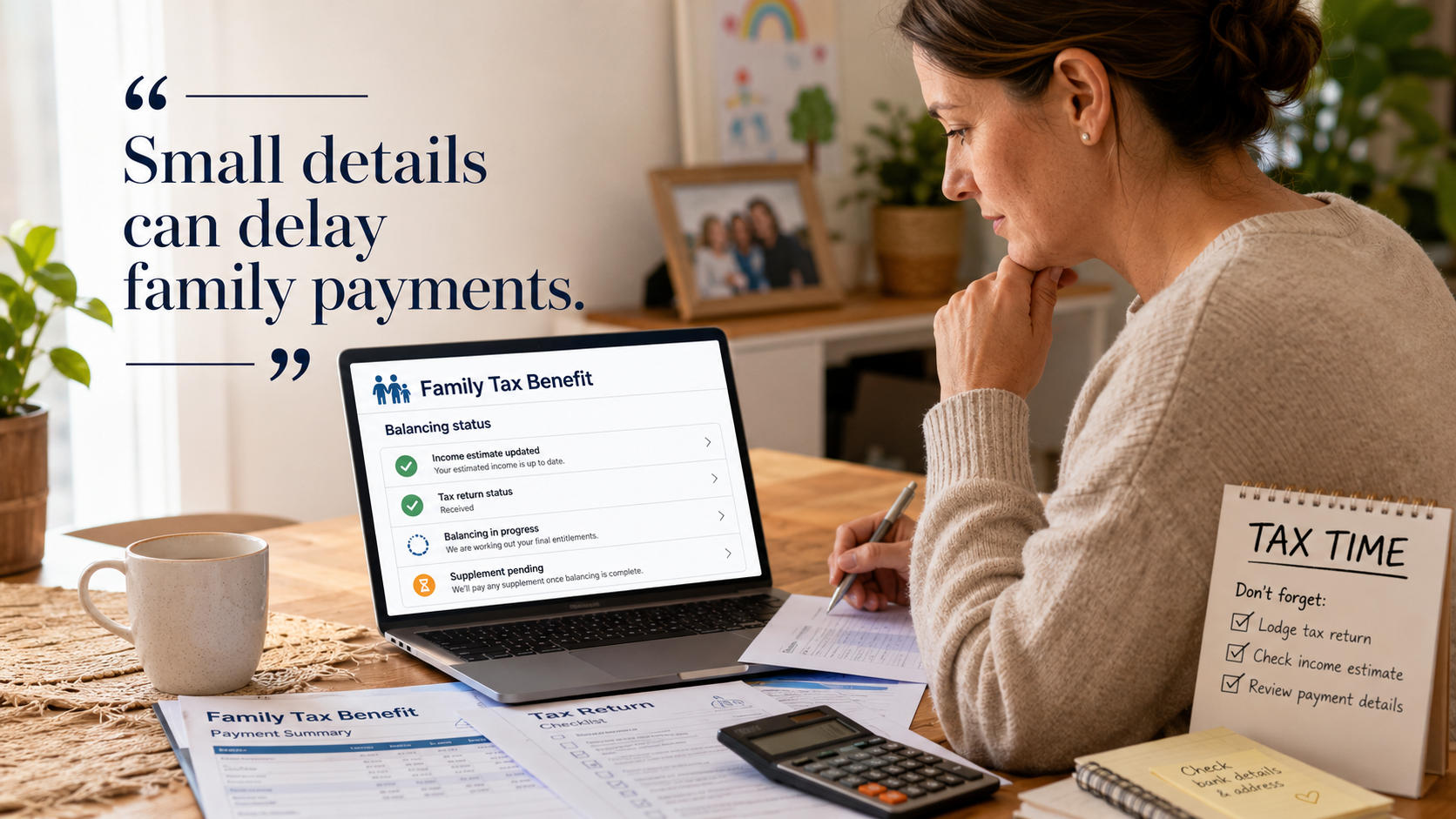
This is where the "leaving money on the table" idea becomes literal rather than just a headline. Family Tax Benefit is often paid during the year based on an income estimate, not the final confirmed figure. Once the financial year ends, Services Australia balances what was paid against what the family was actually entitled to receive.
If the estimate was too high, a family may receive a top-up. If the estimate was too low, there may be a debt. If tax return or non-lodgement details are missing, the process can wait.
A family that assumes the fortnightly amount is the complete picture may be missing the second half of the story. The balancing step can release a top-up or supplement, but only when the required information is there.
It also helps to keep this separate in your head from a tax refund. A tax refund is money the ATO returns because too much tax was withheld during the year, and it is handled entirely through your tax return. FTB balancing is a different process, run by Services Australia, and it can result in a top-up, a supplement, a debt, or no change at all. A family can receive a tax refund and still owe an FTB debt in the same year, or the other way around. The two happen around the same time and both involve government money landing in an account, which is part of why people fold them into one idea, but the systems behind them do not talk to each other.
There is also a reverse problem with the estimate itself. Families sometimes leave an old, higher income estimate sitting on file after a pay cut, a move to part-time work, or a period of parental leave. That can suppress the fortnightly payment for months. The money may be corrected later, but the family still goes through the year with less cash than it may have been entitled to receive at the time.
Services Australia says families receiving FTB or CCS need to estimate family income for the financial year so the right amount can be paid. That estimate should not be treated as a one-time form from July. It is something to revisit when real life changes.
Checking your own situation before assuming the answer
A few questions are worth asking before deciding a payment does not apply.
"Is the family income estimate on file with Centrelink still current, or is it based on an old job, old hours, or last year's overtime?"
"Is the payment being received the maximum rate, a reduced rate, or the base rate, and does that match what the family's actual income suggests?"
"Has the last financial year's Family Tax Benefit actually been balanced, or is a tax return still sitting unlodged?"
These questions do not always require a phone call. Many details can be checked through a myGov account linked to Centrelink. The official estimator can also give a guide before anyone updates a formal claim.
Families going through separation have another detail to check. When care of a child is shared, FTB Part A can be worked out according to the recorded care percentage. That percentage needs to match what is happening now, not an arrangement from a year or two ago that has quietly shifted. A parent who moved from equal shared care to having a child most nights, without updating that record, may be receiving a rate that no longer matches the situation. The opposite can happen too, and it is the kind of change that gets forgotten once the immediate upheaval of separation has settled down.
Grandparent carers and other non-parent carers face a related blind spot. Many assume family payments exist only for parents, so they never check at all. Services Australia can extend Family Tax Benefit to an eligible carer with genuine day-to-day responsibility for a child, not only a biological or adoptive parent. Occasional weekend care is a different situation from being a child's main carer, and it is the actual care arrangement Services Australia looks at, not the relationship label.
Why careful families still miss it
It is tempting to assume missed payments happen to people who are not paying attention. In practice, the opposite is often true.
Families who checked their eligibility carefully once, got a clear answer, and moved on are often the least likely to check again. They feel confident they already know the answer. Thresholds move. Children age into different rate brackets. A partner's hours change. A child moves between households. None of those things automatically triggers a mental reminder to go back and look.
Priya's case was not a system failure. It was a reasonable assumption that simply stopped being reliable. Nothing prompted her to notice until an offhand comment in the office kitchen did the job.
A child's age brings a similar trap later on. Many parents assume FTB Part A ends once a child turns 16. It does not have to, provided the teenager meets the study requirements. For many families with 16 and 17 year olds still in full-time secondary study, this is exactly the kind of detail that can decide whether a payment continues.
This is why the best check is not "Did I qualify years ago?" It is "Do the current rules and current family details still say the same thing?"
Where to actually look
For families who have not checked in a while, the most useful starting point is not a general search result or a comment from another parent. Start with the official Services Australia pages.
Check the FTB Part A income test. Check the current payment rates. Check whether the last financial year has been balanced. Check the income estimate on file. If you are separated, check the care percentage. If you have an older child, check the study status.
It is a fairly small amount of admin for a payment that, across a year, can add up to an amount most households would notice missing from a bank statement.
Priya did not discover a miracle payment. She discovered that an old assumption was out of date. That is less dramatic, but it is far more common. For many families, the missed money is not hidden in a loophole. It is sitting behind a detail they have not checked since life looked different.
Sources
- Services Australia — Family Tax Benefit
- Services Australia — Income test for FTB Part A
- Services Australia — FTB Part A eligibility
- Services Australia — FTB Part A payment rates
- Services Australia — Income test for FTB Part B
- Services Australia — Child Care Subsidy
- Services Australia — Your family income estimate
- Services Australia — Balancing Family Tax Benefit
- Services Australia — Payment and Service Finder