Dental Costs in Australia: Public Waiting Lists vs Private Treatment Compared
Public dental care in Australia can reduce costs if you’re eligible, but waiting times vary. Compare public waiting lists, private dental costs, CDBS, Medicare limits, and what to check before treatment.

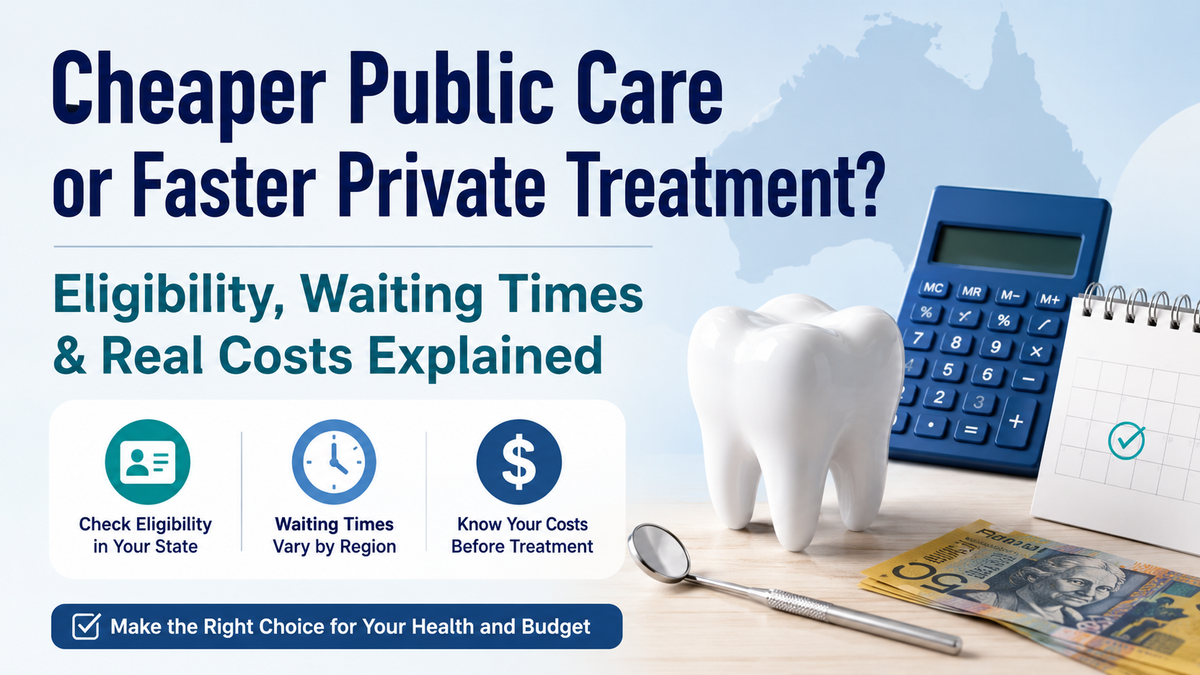
If you've ever had a toothache and searched "public dentist Australia" at midnight, you already know how confusing it gets. One page says public dental care is free, another says you need a concession card, and then a private clinic gives you a quote that makes you wonder whether waiting is the only realistic option.
I had the same confusion the first time I tried to work out what public dental actually covered. It was not as simple as "public is free and private is expensive." The real difference is eligibility, waiting time, urgency, and how much choice you have.
Short answer first
Public dental care in Australia can reduce costs significantly, but it is not open to everyone and it is usually run by state and territory governments. Adults generally need to meet eligibility rules, often linked to a Health Care Card, Pensioner Concession Card or similar concession status. Children may have broader access, especially through school dental services or the Child Dental Benefits Schedule.
Private dental treatment is easier to access and gives you more choice over dentist, location and timing, but the cost can vary widely. Medicare does not usually cover routine adult dental treatment, and private health insurance extras may only pay part of the bill.
The main trade-off is this: public dental may be cheaper if you are eligible, but waiting times depend heavily on where you live and how urgent your problem is. Private dental is usually faster, but you need to understand the quote, the item numbers and your out-of-pocket cost before treatment starts.
Public dental care is not one national system
This is where people often get caught. Australia has Medicare, so it is easy to assume dental care works the same way as seeing a GP. It usually does not.
Public dental services are mostly organised by state and territory governments. That means the rules in NSW can be different from Victoria, Queensland, South Australia or Western Australia. Even the fees can look different. Some states provide free public dental care for eligible adults, while others charge a co-payment or subsidise part of the treatment cost.
NSW, for example, says eligible adults can receive free dental care from NSW public dental clinics. If you are not eligible, you generally need to see a private dentist. You can check the rules on the NSW Health public dental services page.
Victoria works differently. Eligible adults can access public dental services, but fees may apply. Oral Health Victoria lists a fee per visit for adults with a concession card, with a maximum for a general course of care. The current fee information is on the Oral Health Victoria fees page.
Queensland has its own rules again. Queensland Health says eligible adults and their dependants can access free public dental care if they are Queensland residents and hold an accepted concession card such as a Health Care Card, Pensioner Concession Card, Commonwealth Seniors Health Card or Queensland Seniors Card. The eligibility rules are on the Queensland public dental services page.
So before you compare public and private costs, the first question is not "How much is public dental?" It is "Am I eligible in my state?"
Who can usually use public dental?
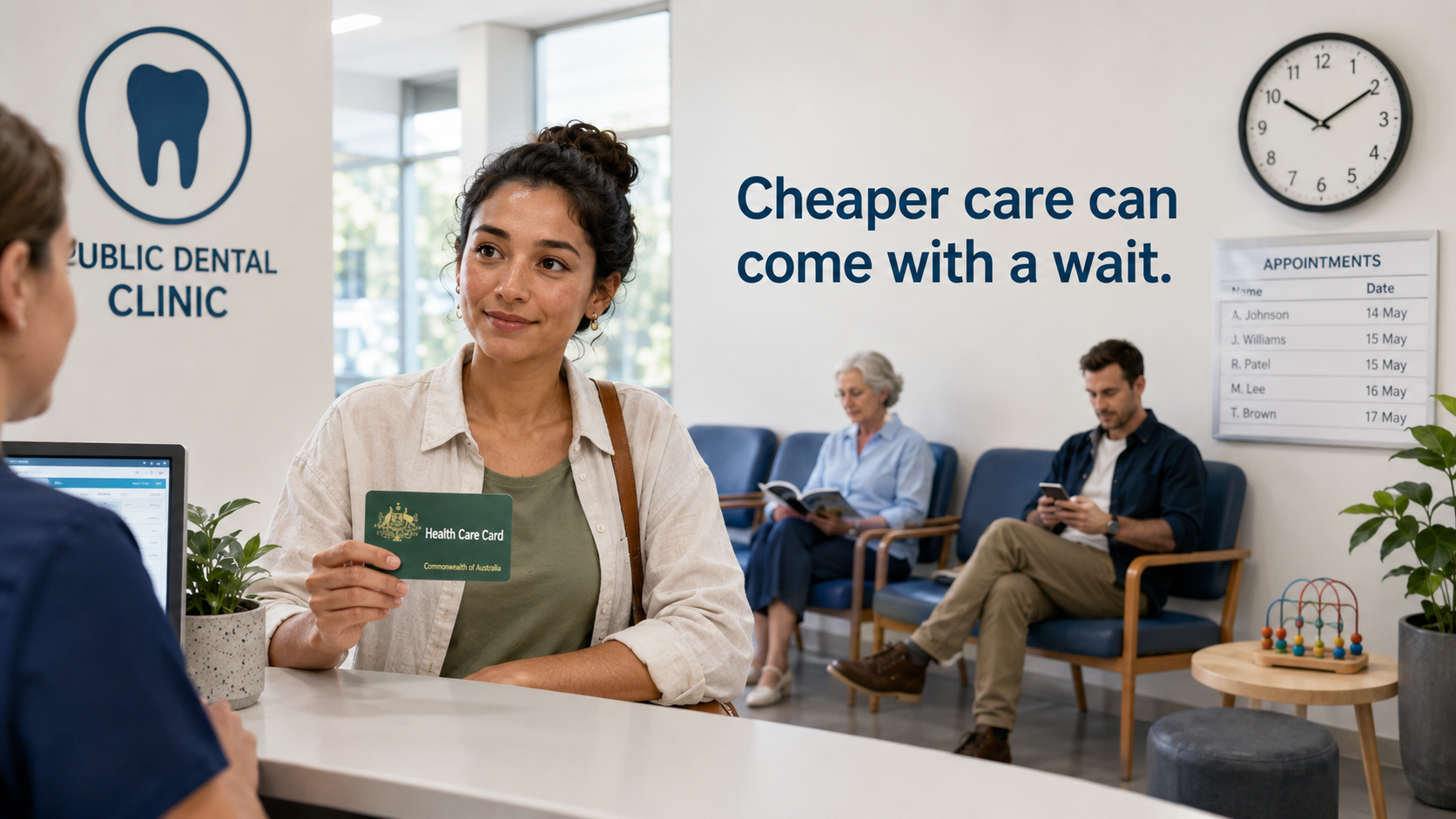
For adults, public dental eligibility is often linked to concession status. In many states, adults need to hold a current Health Care Card, Pensioner Concession Card or similar card. Some groups may also have priority access — such as Aboriginal and Torres Strait Islander people, refugees, asylum seekers, people experiencing homelessness, pregnant people or people with urgent dental problems depending on the state.
The exact rules matter. South Australia says adults must live in SA and hold a current Health Care Card or Pensioner Concession Card to attend SA Dental clinics. It also notes that adult dependants aged 18 to 21 may be eligible if listed on the card, but a partner listed on someone else's concession card is not eligible unless they hold their own card. The details are on the SA Dental adults eligibility page.
Western Australia uses a subsidy model. Dental Health Services WA says Health Care Card and Pensioner Concession Card holders may be eligible for subsidised public dental care, with treatment at public dental clinics subsidised by the WA Government up to a maximum of 75% of the cost. The rules are on the WA General Dental Service page.
Children are a bit different. Many children can access public dental services through school dental programs or public clinics. Some are also eligible for the Child Dental Benefits Schedule, which can cover basic dental services up to a set cap over two calendar years. Services Australia explains eligibility on the Child Dental Benefits Schedule page.
That means a family might have one pathway for children and a completely different pathway for adults. It is worth checking both separately.
Waiting lists are the real cost of public dental
Public dental is not just about the fee at the clinic. The other cost is time.
Routine public dental care often involves a waiting list. Emergency dental problems are usually handled differently, but general check-ups, fillings, dentures and non-urgent treatment may take longer depending on your location and local demand. Victoria explains this clearly: waiting lists are used for people who need routine dental care, while emergency and priority clients are handled differently. You can read the current information on Victoria's public dental care waiting list page.
NSW data shows big differences by region. On 31 March 2026, 100% of people in South Western Sydney, Illawarra Shoalhaven and several other local health districts waited less than the maximum recommended time, while Justice Health was only at 49%. State averages can look reassuring while individual regions are much worse. The current reporting is on the NSW public dental waiting list page.
This is why two people can have very different experiences. Someone with facial swelling, dental trauma or severe pain may be triaged differently from someone waiting for a routine clean or denture adjustment. If you are in pain, it is worth calling the clinic and asking to be assessed as urgent rather than joining the general list and waiting.
The uncomfortable truth is that "cheaper" may not feel cheaper if the problem gets worse while you wait. For a routine check-up, waiting might be reasonable. For worsening pain or infection, it may not be.
Private dental is faster, but the bill can surprise you
Private dental care usually gives you more choice. You can choose the clinic, compare appointment times, ask for a second opinion and often be seen much faster than through a public waiting list. That matters if you are in pain, have work or caring responsibilities, or need treatment before the problem becomes bigger.
The trade-off is cost. Medicare does not cover routine adult dental, which is one of the biggest reasons dental costs feel so different from other health costs in Australia. Private health insurance with extras may help, but the fund usually pays only part of the cost, and annual limits apply. Policies vary widely some pay a set benefit per item number, some pay a percentage of the fee, and some have waiting periods for major dental.
This is the part that catches people with extras cover. Having dental extras does not mean the treatment is free. A check-up and clean may be covered more generously than a crown, root canal or dentures. Before treatment starts, ask the dentist for the item numbers and call your health fund to ask exactly how much they will pay for each one. The Australian Government's PrivateHealth.gov.au can help compare policies if you are shopping for cover.
In some states, public patients may be offered a voucher to see a private dentist. If you are offered one, call the clinic before booking to confirm whether they accept that voucher and whether any gap fee applies.
What Medicare and CDBS do and do not cover
Medicare does not usually cover routine dental treatment for adults. That is one of the biggest reasons dental costs feel so different from other health costs in Australia.
Children may have a separate pathway through the Child Dental Benefits Schedule. CDBS can cover part or all of the cost of basic dental services for eligible children examinations, X-rays, cleaning, fissure sealing, fillings, root canals and extractions but it does not cover orthodontic, cosmetic or hospital dental services. As of January 2026, Services Australia lists the cap as $1,158 over two calendar years for each eligible child. Because the cap is indexed, it is worth checking the current amount on the CDBS covered services page rather than relying on an older figure.
For families, this can make a significant difference. A child may have CDBS available while the parent has no Medicare dental cover at all. If you are booking for a child, ask the clinic before the appointment whether they accept CDBS and whether they bulk bill it or charge a gap.
So when does this actually help?
Public dental is most useful when you are eligible, the treatment is not urgent, and the waiting time is manageable for your situation. It can make a big difference for adults on concession cards, older people needing dentures, and families with eligible children who would otherwise delay treatment because of cost.
Private dental is most useful when timing matters, you want more choice, or you need treatment that public services may not provide quickly. It also makes more sense when you have extras cover and the out-of-pocket cost after the health fund benefit is manageable.
The hard cases are the ones in the middle a cracked tooth that is not yet infected, a painful wisdom tooth that comes and goes, a denture that still works but makes eating difficult. These are the situations where people wait because they do not want the private bill, but the problem may become more expensive if it deteriorates.
The better question is not "public or private?" It is "What happens if I wait, and what will it cost me if this gets worse?"
A few things to watch for
The first trap is assuming public dental is available to everyone. It is not. Adult eligibility usually depends on your state, concession card status and the type of care needed. Having a low income does not automatically qualify you in many states, you generally need an accepted concession card.
The second is assuming private health insurance will cover the bill. Extras cover may help, but limits, waiting periods and item-number rules can leave you with a large gap. Ask for the item numbers before treatment and check with your fund before you agree.
Dental infections are another area where people wait too long. Pain that is worsening, facial swelling, fever, pus, difficulty swallowing or trouble opening your mouth should be checked urgently. Once a dental infection starts spreading it is not just a tooth problem.
People also get caught by assuming one state's rules apply in another. A concession card that gives you free public dental in one state may produce a different fee or pathway somewhere else. If you have recently moved, check the rules in your new state rather than assuming they match.
Finally, CDBS and public dental are focused on clinically necessary treatment. Whitening, cosmetic veneers and most orthodontic work are usually outside both systems.
How to check
Start with your state public dental service. Search your state name plus "public dental eligibility" and check whether your concession card, age, or circumstances make you eligible. If you are unsure, call the clinic and describe the problem rather than just asking "Am I eligible?" clinics can usually give a clearer answer when they know what the issue is.
If you call a public dental clinic, useful questions include:
"Am I eligible for public dental care with my card?"
"Is this treated as urgent or routine dental care?"
"How long is the current wait for general dental treatment in this area?"
"Are there any fees or co-payments for my situation?"
"Can I use CDBS for my child, and will there be a gap?"
If you call a private clinic, ask for the item numbers before agreeing to treatment. Then call your health fund and ask:
"How much will you pay for these item numbers?"
"Is there a waiting period or annual limit that applies?"
"What will my out-of-pocket cost be?"
That one step can prevent the awkward moment of finding out after treatment that your extras cover paid much less than you expected.
For CDBS, check your child's balance in the Medicare section of myGov. The cap resets every two calendar years, and unused balance does not carry over indefinitely.
The bottom line
Public dental care can reduce costs significantly if you meet the rules, but waiting times depend on where you live and how urgent your problem is. Private dental is usually faster and gives you more choice, but the bill can vary widely and extras cover rarely removes the need to check the quote and item numbers first.
If you are deciding between public waiting lists and private treatment, start with eligibility, urgency and a real quote. Rules, fees and waiting pathways change, so it is worth checking your state public dental service, Services Australia for CDBS, and your health fund before making a decision.
Sources
- Services Australia — Child Dental Benefits Schedule
- Services Australia — What's covered by the Child Dental Benefits Schedule
- NSW Health — Public dental services information for patients
- NSW Health — Public dental care waiting list data
- Oral Health Victoria — Are you eligible?
- Queensland Government — Public dental services
- SA Dental — Who can attend our dental clinics
- healthdirect — Cost of dental care