No Energy Rebate on Your Bill? Here's What Changed in 2026
No energy rebate on your bill in 2026? Learn what changed, why credits may be missing, and how concession cards, state rebates and retailer checks can still help.

A missing energy rebate is annoying because you usually only notice it after the bill has arrived.
You open the bill, search for “rebate” or “government credit,” and find nothing. Maybe the retailer missed it. Maybe your concession card is not registered. Or maybe the program you were expecting has already ended.
That last part matters in 2026. The broad federal bill relief credits have ended, but state-based concessions are still available for many eligible card holders.
This guide explains why a rebate may be missing from your electricity bill and what to check before assuming you have missed out.
Short answer first
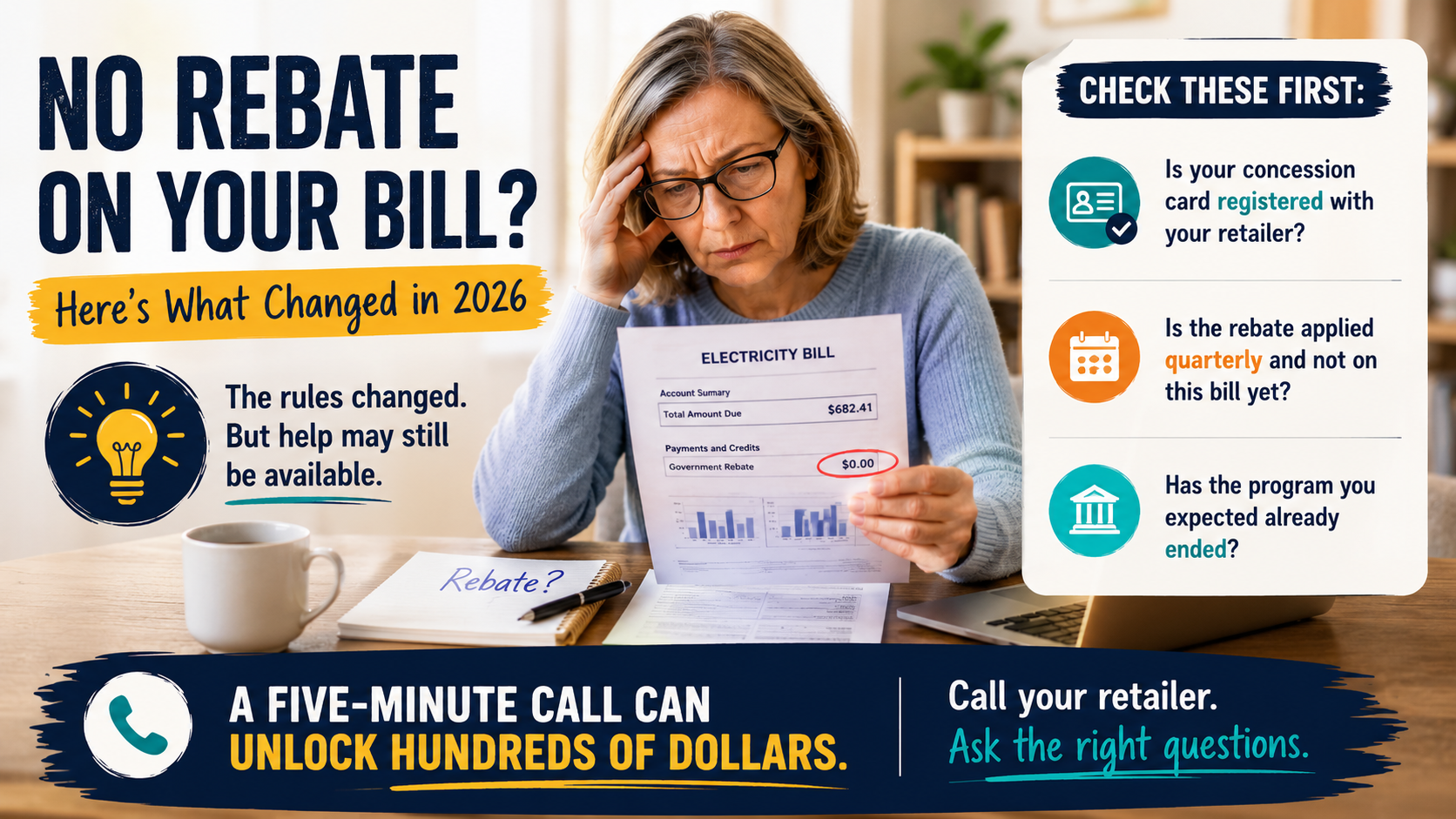
Most missing rebates come down to one of three things: your concession card is not registered with your retailer, the credit is applied quarterly and has not reached your bill yet, or the federal program you were expecting has already ended. But state-based concessions may still be available if you hold an eligible card.
The fix is usually a five-minute phone call to your energy retailer, but only if you know exactly what to ask. We'll get to that in a minute.
The rebate situation changed at the end of 2025
This is where a lot of people get caught, because the rules shifted and not everyone got the memo.
The federal Energy Bill Relief Fund, the automatic credit that appeared on every household's electricity bill, ended on 31 December 2025. Between July and December 2025, eligible households received up to $150 in two $75 quarterly instalments. Before that, in 2024-25, there was an earlier round worth up to $300. Those programs are both finished now. As of early 2026, households need to check current federal and state rebate pages for any new support. If you didn't see those credits at the time and you were on a standard grid connection, it's worth calling your retailer to find out what happened, but that window has mostly closed.
What hasn't closed is the network of state-level concessions for card holders. These run independently of the federal fund and are still active. The problem is that a lot of eligible people aren't receiving them, usually because their concession card details aren't registered with their retailer.
There are actually three types of rebate, and they work differently
When someone says "the energy rebate," they could mean different things. That's where the confusion starts.
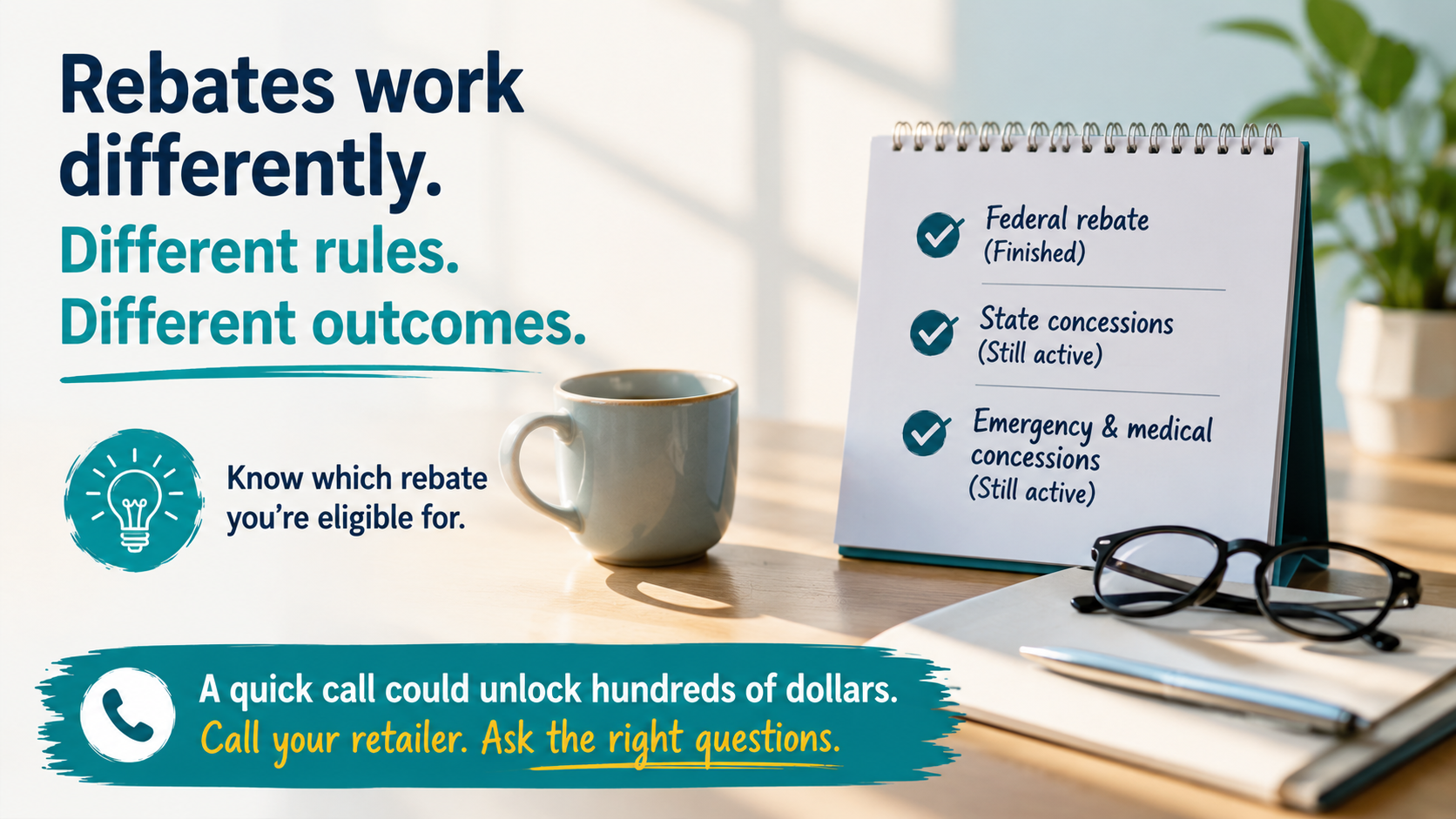
The first is the federal Energy Bill Relief Fund, which was the automatic credit that went to all households regardless of income. As of January 2026, this one is finished. For any new federal support, check the current Energy Bill Relief Fund and energy.gov.au rebate pages rather than relying on last year's bill credit.
The second is your state concession. NSW has the Low Income Household Rebate. Victoria has the Annual Electricity Concession. Queensland has the Electricity and Natural Gas Rebate for pensioners and seniors. South Australia has the Energy Bill Concession. These are separate from the federal one, they're still running, and they only apply if you hold a Pensioner Concession Card, Health Care Card, DVA card, or in some cases a Commonwealth Seniors Health Card. They also require you to register your card with your retailer. It doesn't happen automatically.
The third category covers emergency and medical concessions, things like the Life Support Rebate, the Medical Cooling Concession, and Energy Accounts Payment Assistance. These are case-by-case and need forms, but they're also still active for eligible households.
To make it more confusing, your bill may simply say "Govt Rebate" without explaining which rebate it refers to. That's part of why it feels like money has vanished.
How this plays out for real households
Let's say you're a pensioner in Brisbane with a Pensioner Concession Card. The federal credits are gone, but Queensland's Electricity Rebate of $386.34 per year is still available, applied through your retailer once your card is registered. If you switched retailers recently and didn't tell them about your card, that concession likely stopped.
Or you're a self-funded retiree in NSW with a Commonwealth Seniors Health Card. The Seniors Energy Rebate of $200 per year is still available, but it requires an annual application through Service NSW. It's not automatic, and it's not the same as the Low Income Household Rebate, which is a separate program for Pensioner Concession Card and DVA card holders. In fact the two are mutually exclusive: if you're on one, you can't also claim the other. Two people on different card types can end up with quite different outcomes, even in the same state.
Rules vary by state and by card type, which is why two neighbours can end up in different situations.
A few things to watch for
The biggest trap is assuming state concessions work like the federal rebate did. The federal one was automatic if you had an electricity account. State concessions require you to tell your retailer what card you hold. If you switched retailers and forgot to mention your card, the concession stopped the day you switched.
Timing catches people out too. Retailers apply quarterly credits on the first bill issued after specific dates. If your bill cycle doesn't line up neatly, you might be looking at a bill that simply hasn't hit the instalment date yet.
If you've moved house, concessions don't follow you. New address means re-registering your card with the retailer, even if it's the same company.
Health Care Cards also expire. If yours lapsed and you got a new one, the retailer doesn't know unless you tell them. Same goes for any card where the number changed.
If you live in an apartment building, retirement village, or caravan park where the body corporate buys electricity in bulk, you're on what's called an embedded network. Rebates work differently there. You usually have to apply through your state government rather than your retailer, and the process varies by state. This catches a lot of people who assume the credit will just appear.
How to check
Start with your most recent bill. Look for any line items that include the words "concession," "rebate," or "government." If there's nothing there and you hold a concession card, grab the card and call your retailer. Don't email. Call.
Ask these exact questions: "Can you confirm if my concession card is registered on my account?" "Is there a state concession I should be getting with this card type?" If they say no to the first one, give them your card number and expiry date. It should apply from your next bill.
Ask whether any missed concession can be backdated. The answer depends on your state, retailer and eligibility dates, so do not assume it will happen automatically.
If you're on an embedded network, the process is different. You'll need to apply directly through your state government. Current details for each state are on the Rebates and Assistance page on energy.gov.au, which lets you search by state and card type.
One more thing worth checking: if your concession card details appear current in myGov but your retailer says the card isn't valid, ask Services Australia for a letter of confirmation. Sometimes the update between systems takes time.
What if you're not on a concession card?
If you don't hold any of those cards, the ongoing state concession programs won't apply. But it's worth checking whether you might qualify for one. Income thresholds for the Low Income Health Care Card and Commonwealth Seniors Health Card are indexed and reviewed each financial year. If you applied before and were just over the limit, the current figures on the income test for Commonwealth Seniors Health Card may be worth revisiting.
For share houses, one thing to keep in mind: state concessions are typically applied per account holder, not per property. If your name isn't on the bill, the concession goes to whoever is. The same applied to the federal credits when they were running.
While you're at it, check your plan
Once you've sorted the rebate question, it's worth spending another five minutes on the broader bill. The ACCC has flagged repeatedly that households on the same electricity plan for more than a year are often paying above-market rates. Retailers tend to offer their best deals to new customers, and loyal customers quietly end up on less competitive plans once the introductory period ends.
From 1 July 2026, reforms to the Default Market Offer framework take effect in NSW, South East Queensland and South Australia, including a new government-backed Solar Sharer Offer designed to give more households access to cheaper daytime electricity. That's a floor, not a ceiling though. The government comparison tools are free, independent, and don't earn commissions. Energy Made Easy covers NSW, Queensland, SA, ACT, and Tasmania. Victorian Energy Compare covers Victoria. You enter your postcode and recent bill details, and they show you all available plans ranked by annual cost. Switching retailer doesn't interrupt your supply. It takes a few weeks to process and in some cases can save several hundred dollars a year.
There's also some news on the pricing side worth knowing. From 1 July 2026, the Default Market Offer, the benchmark price cap set by the Australian Energy Regulator, is falling for most households in NSW and South East Queensland. South Australia is more mixed: small business prices there are falling too, but residential prices are actually edging up slightly for 2026-27. Victoria runs on its own system, the Victorian Default Offer, and the state regulator has set lower default electricity prices for both households and small businesses from 1 July 2026. If you're currently on a standing offer and haven't shopped around recently, it's worth checking whether both the cap and the available market deals in your area are now lower than what you're paying.
Where this leaves you
The universal federal rebate that went to every household is finished. If you're waiting for that same universal credit to appear in 2026, it's unlikely to show up.
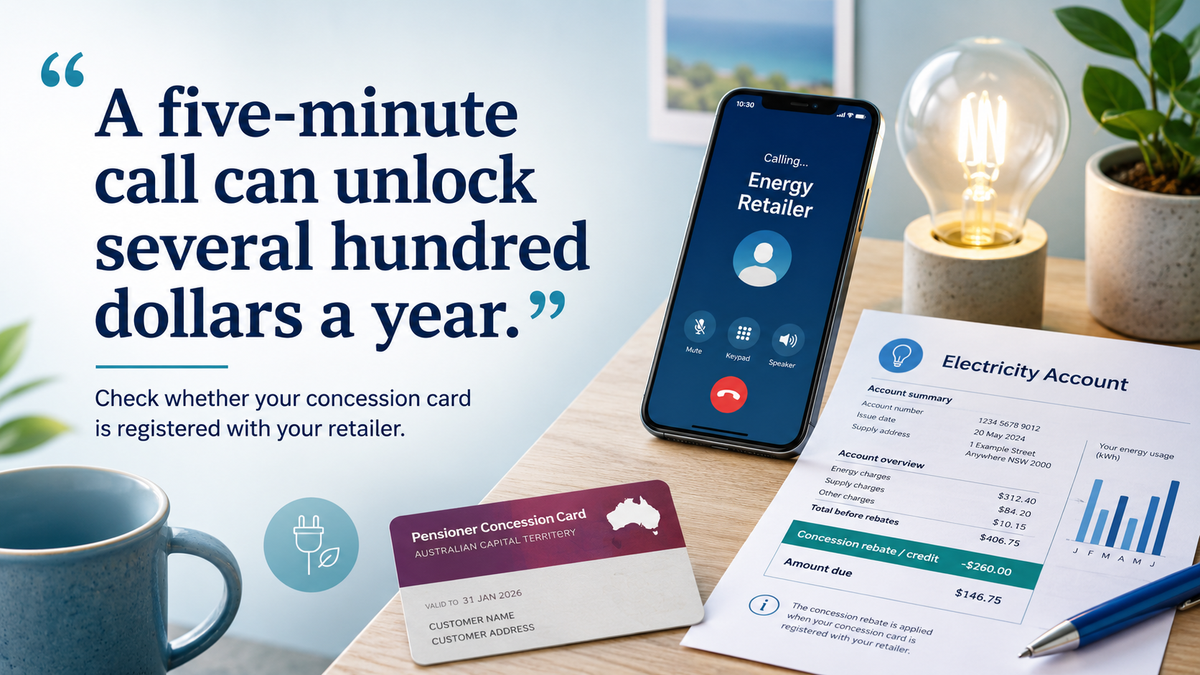
What's still available are the state-level concession programs for card holders, and a significant portion of eligible Australians aren't receiving them simply because their retailer doesn't have their card on file. If you hold a Pensioner Concession Card, Health Care Card, Commonwealth Seniors Health Card, or DVA card and you haven't confirmed your details are registered, that's the most useful thing you can do this week. A five-minute call can unlock several hundred dollars a year.
Rebate amounts and eligibility rules are reviewed regularly, so check current figures through your state government's website or the energy.gov.au rebates directory rather than relying on what applied a year ago.
Sources
Energy Bill Relief Fund - energy.gov.au
Rebates and Assistance - energy.gov.au
Income test for Commonwealth Seniors Health Card - Services Australia
Energy Made Easy - Australian Government
Victorian Energy Compare - Victorian Government