Stillbirth and Newborn Death Financial Support in Australia: What Parents May Be Able to Claim (June 2026)
Learn what financial support may be available after stillbirth or newborn death in Australia, including Stillborn Baby Payment, Parental Leave Pay, Family Tax Benefit bereavement payments, workplace leave and practical support.

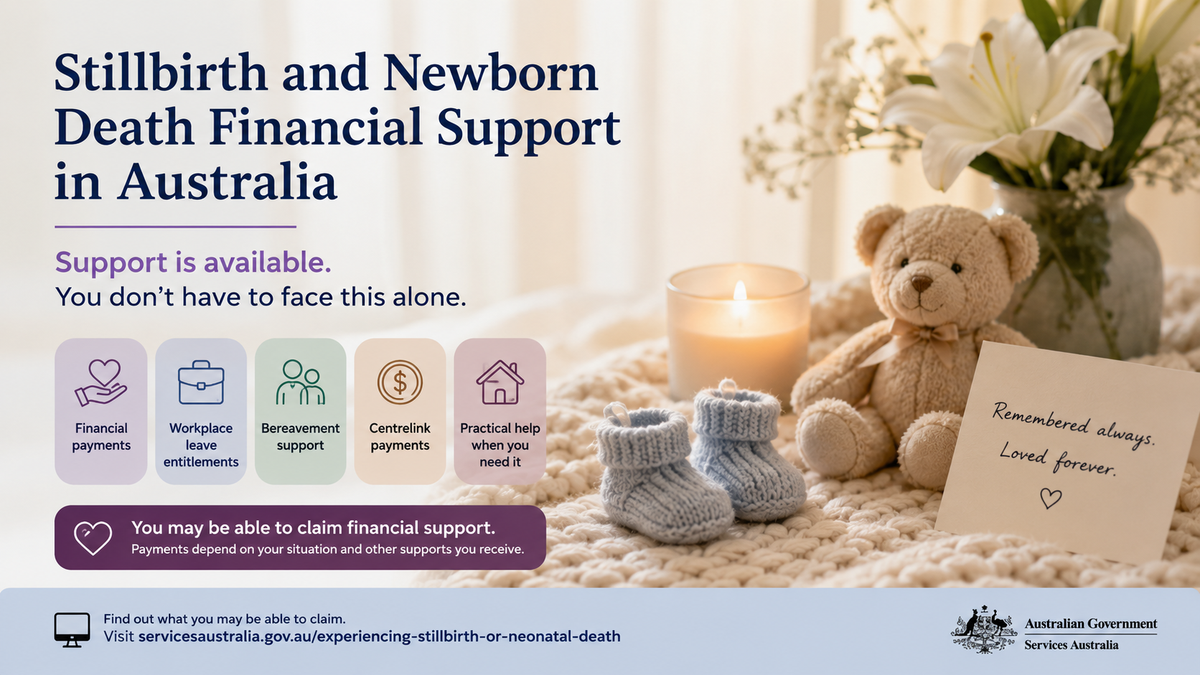
When a baby is stillborn or dies shortly after birth, dealing with Centrelink claims, workplace leave and funeral arrangements can feel overwhelming.
The rules are not simple because the support available depends on whether the baby was stillborn or born alive, the parent’s work history and income, and whether the family was already receiving payments such as Family Tax Benefit or Parenting Payment.
Some payments can be received together. Others require parents to choose one option.
This guide explains the main government payments, workplace entitlements and practical support that may be available in Australia, based on information available as of June 2026.
Short answer first
Parents who experience stillbirth or the death of a newborn may be able to receive financial support, but the payments are not automatically issued in every case.
For a stillbirth, an eligible parent may need to choose between:
You generally cannot receive both payments for the same stillborn baby.
If a baby was born alive and later died, Stillborn Baby Payment does not apply. Eligible parents may be able to continue receiving Parental Leave Pay and may also qualify for Family Tax Benefit bereavement payments.
A single parent whose only qualifying child dies may also continue receiving Parenting Payment for up to 14 weeks, if they remain eligible.
Claims are usually made through a Centrelink online account linked to myGov. Workplace leave is separate and should also be checked directly with the employer.
The Services Australia page for families experiencing stillbirth or neonatal death is the best place to begin.
What support exists in plain English
The Australian Government does not provide one universal payment called a newborn death payment.
Instead, Services Australia assesses the family under several existing payment systems. Depending on the circumstances, these may include:
- Stillborn Baby Payment
- Parental Leave Pay
- Family Tax Benefit bereavement payments
- Newborn Upfront Payment and Newborn Supplement
- Temporary continuation of Parenting Payment or some other income-support payments
The most important distinction is whether the baby was stillborn or born alive and later died.
For a stillborn baby, an eligible parent may need to choose between Stillborn Baby Payment and Parental Leave Pay.
For a baby who was born alive and later died, Parental Leave Pay may continue, and Family Tax Benefit bereavement provisions may also apply.
The Payment and Service Finder may help identify possible payments. However, bereavement claims can involve several interacting rules, so contacting the Child bereavement and Double Orphan Pension helpdesk or Centrelink Families line may help clarify what applies.
Older payment names can be confusing
Older articles may refer to the Baby Bonus or former maternity payments.
Those are not the current payments used for a new stillbirth or newborn-death claim. Current claims are assessed under Stillborn Baby Payment, Parental Leave Pay and relevant Family Tax Benefit bereavement rules.
The term “bereavement payment” can also be confusing.
Family Tax Benefit bereavement payments apply after a child who was included in the family’s FTB assessment dies. Stillborn Baby Payment is a separate one-off payment with different eligibility conditions.
If an older article lists a payment name or amount that does not appear on the current Services Australia website, check the official pages before relying on it.
Stillbirth and neonatal death are treated differently
In Australia, a stillbirth generally means the birth of a baby without signs of life from 20 weeks of pregnancy.
If the length of the pregnancy is not known, the birth may be treated as a stillbirth where the baby weighs at least 400 grams.
A miscarriage generally refers to pregnancy loss before 20 weeks, so Stillborn Baby Payment may not apply.
A neonatal death usually means that a baby was born alive and died within the first 28 days after birth. Services Australia may also use broader terms such as infant death or the death of a child.
You can read more about the Australian definition on the government-funded Pregnancy, Birth and Baby stillbirth page.
This distinction determines which payments may be available and whether the parent must choose between them.
Stillborn Baby Payment
The Stillborn Baby Payment is a one-off, tax-free payment for eligible families following a stillbirth.
As of June 2026, the payment is $4,326.57 for each eligible stillborn baby.
The claimant generally needs to meet conditions including:
- The baby meets the payment definition of stillbirth
- The claimant or their partner would have been the baby’s main carer
- Parental Leave Pay is not being received for the same baby
- Residence requirements are met
- The relevant income test is met
The income test uses the family’s expected adjusted taxable income for the six months after the baby’s delivery.
As of June 2026, the published income limit is $77,177 for that six-month period.
A family above this limit may still qualify in some circumstances if it receives, or becomes eligible for, Family Tax Benefit Part A for another child within 52 weeks of the delivery.
The payment is not automatic. A claim normally needs to be submitted through a Centrelink online account linked to myGov.
The usual claim deadline is 52 weeks from the baby’s date of birth. Additional time may be considered in limited circumstances, including severe illness connected with the birth or an unsuccessful Parental Leave Pay claim.
Check the current eligibility rules, payment amount and claim process before applying.
Parental Leave Pay
Parental Leave Pay may be available when a baby is stillborn or dies after birth, provided the claimant meets the usual eligibility requirements.
These generally include:
- The work test
- The income test
- Residence requirements
- Submitting a valid claim within the relevant timeframe
The work test generally requires a person to have worked during at least 10 of the 13 months before the birth or stillbirth.
They normally need to have completed at least 330 hours of work during the relevant 10-month period, with no gap of more than 12 weeks between working days.
Some exceptions may apply where pregnancy complications, premature birth or other specified circumstances affected the person’s ability to work. Check the current Parental Leave Pay work requirements rather than assuming that a break from work makes the person ineligible.
The number of available Parental Leave Pay days depends on the baby’s date of birth.
For a baby born between 1 July 2025 and 30 June 2026, an eligible family may receive up to 120 days, equivalent to 24 weeks based on a five-day week.
For a baby born from 1 July 2026, the maximum increases to 130 days, equivalent to 26 weeks based on a five-day week.
Parental Leave Pay is taxable. Its daily rate is linked to the National Minimum Wage and may change from 1 July.
Check the current Parental Leave Pay eligibility rules and payment rate and number of days.
Parental Leave Pay sharing rules after stillbirth or neonatal death
Under the general Paid Parental Leave rules, some days are reserved for the other parent when the claimant has a partner.
However, stillbirth or the death of a child is an exemption to the reserved-days limit.
This means one eligible parent may be able to claim all available Parental Leave Pay days without having to allocate the reserved portion to their partner.
Parents can still choose to share the payment. If they do, each parent must make a separate claim and meet the eligibility rules.
Families experiencing stillbirth or neonatal death also have an exemption to the usual limit on how many Parental Leave Pay days parents can take at the same time. This may allow both eligible parents to receive some or all of their days concurrently.
Services Australia explains these rules on its pages about stillbirth or neonatal death and exemptions to the reserved-days limit.
Choosing between Parental Leave Pay and Stillborn Baby Payment
For a stillborn baby, the family generally cannot receive both Parental Leave Pay and Stillborn Baby Payment for the same child.
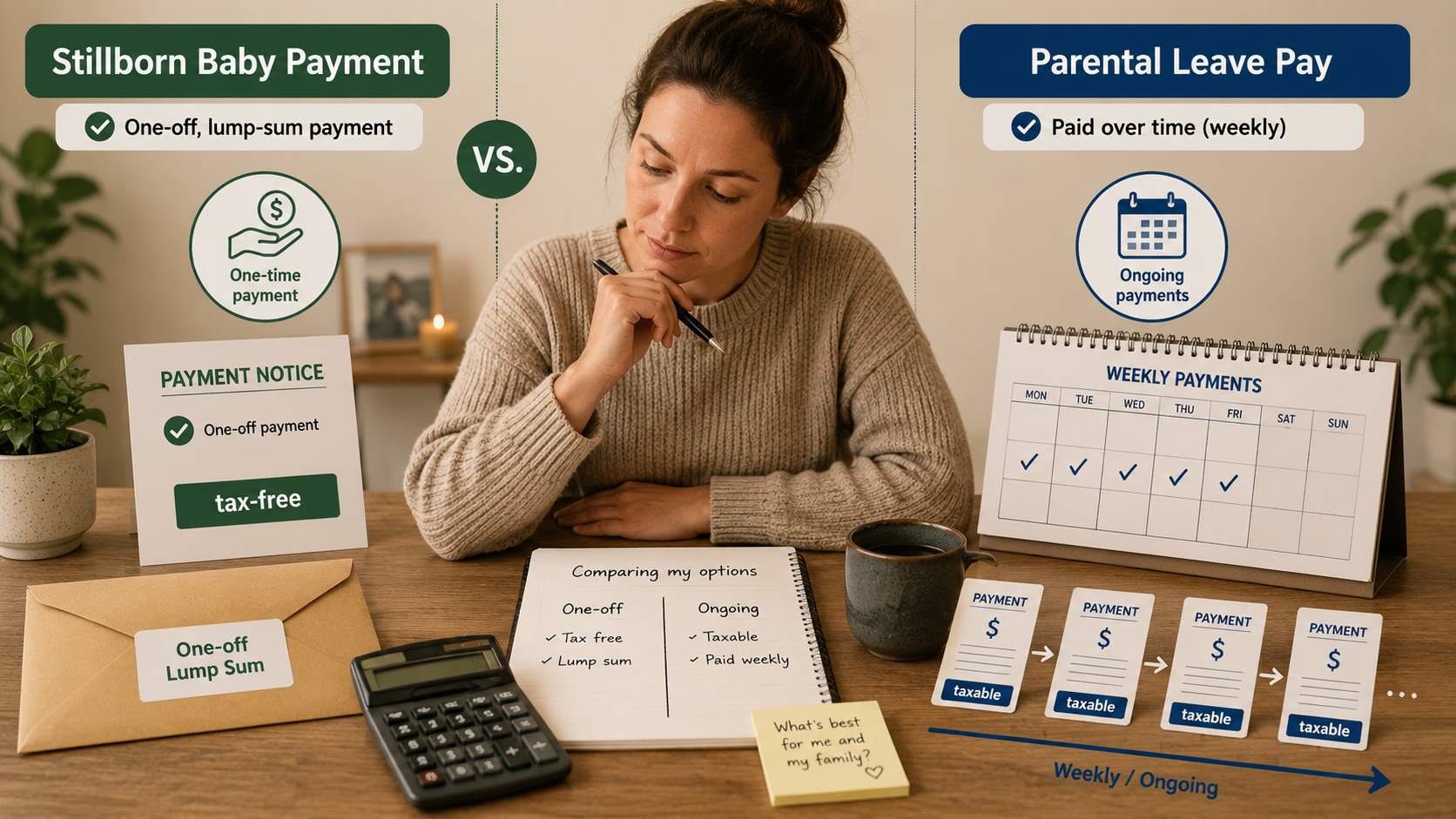
Parental Leave Pay may provide a larger total amount because it is paid over a number of days. However, it is taxable and requires the claimant to meet the work, income and residence rules.
Stillborn Baby Payment is a one-off, tax-free amount. It does not use the same work test but has its own family income test.
The better option depends on:
- Eligibility for each payment
- The total amount available
- Whether the payment is taxable
- Whether a lump sum or payments over time better suit the family
- How the choice interacts with Family Tax Benefit and other payments
Services Australia provides a direct comparison on its page about deciding between Stillborn Baby Payment and Parental Leave Pay.
For multiple births, different combinations may apply. For example, Parental Leave Pay may apply for one baby while Stillborn Baby Payment may be available for another stillborn baby.
Direct advice from Services Australia is particularly useful in multiple-birth cases.
What if the baby was born alive and later died?
If a baby was born alive and later died, Stillborn Baby Payment does not apply.
An eligible parent may continue receiving Parental Leave Pay. In these circumstances, the parent may also return to work on a day they receive Parental Leave Pay.
Family Tax Benefit bereavement payments may also apply.
If the family is eligible for FTB Part A, payment may continue for up to 14 weeks after the child’s death. Depending on the circumstances, it may be paid as continuing fortnightly payments or as a lump sum.
FTB Part B bereavement provisions may also apply for up to 14 weeks. However, FTB Part B and Parental Leave Pay generally cannot be paid for the same days.
Some families may qualify for Newborn Upfront Payment and Newborn Supplement with an FTB bereavement payment. These payments generally cannot be received for the same child as Parental Leave Pay.
A single parent whose only qualifying child dies may continue receiving Parenting Payment for up to 14 weeks. After that period, they may need to claim a different income-support payment if they no longer meet the Parenting Payment rules.
Services Australia explains these arrangements on its pages about help when a child dies, Family Tax Benefit when a child has died and Parental Leave Pay with an FTB bereavement payment.
Workplace leave may also apply
Government payments and workplace leave are separate.
A parent may qualify for a Centrelink payment even if the employer does not provide paid parental leave. A person may also have workplace leave entitlements even if they do not qualify for Parental Leave Pay.
Under the National Employment Standards, an eligible employee whose baby is stillborn, or whose child dies within the first 24 months of life, may take up to 12 months of unpaid parental leave.
The employer cannot require the employee to return to work or cancel that unpaid parental leave solely because of the stillbirth or death.
An employee who decides to return early may do so. If the leave has already started, the employee normally needs to give at least four weeks’ written notice unless an earlier date is agreed.
Employees may also have access to compassionate leave, although how it can be used may depend on whether unpaid parental leave has already started. Awards, enterprise agreements and workplace policies may provide additional entitlements.
Since 7 November 2025, Baby Priya’s Law has provided additional protection for employer-funded paid parental leave.
Where an employer provides paid parental leave, it generally cannot refuse or cancel the leave solely because the child was stillborn or died after birth, subject to the exceptions set out by Fair Work.
The law does not require every employer to introduce a paid parental leave scheme.
Employees should check:
- Their employment contract
- Their award or enterprise agreement
- The employer’s parental leave policy
- Compassionate or bereavement leave
- Accrued personal and annual leave
Fair Work provides guidance on stillbirth, premature birth and the death of a child and Baby Priya’s Law.
Funeral and burial costs
There is no single national funeral payment that covers every stillbirth or newborn death.
Stillborn Baby Payment may be used toward funeral or memorial expenses, but it is not calculated according to the actual funeral bill. It also does not apply where the baby was born alive.
Hospitals often have social workers, bereavement midwives or pastoral care teams who can help with:
- Funeral-director referrals
- Birth and death documentation
- Local burial or cremation arrangements
- State-based funeral assistance
- Counselling and emergency-relief referrals
Funeral assistance for a family without sufficient financial resources is generally managed at the state or territory level.
For example, families in NSW can review government information on ways to pay for a funeral.
Rules differ across Australia, so ask the hospital social worker what applies locally before agreeing to costs that may be difficult to meet.
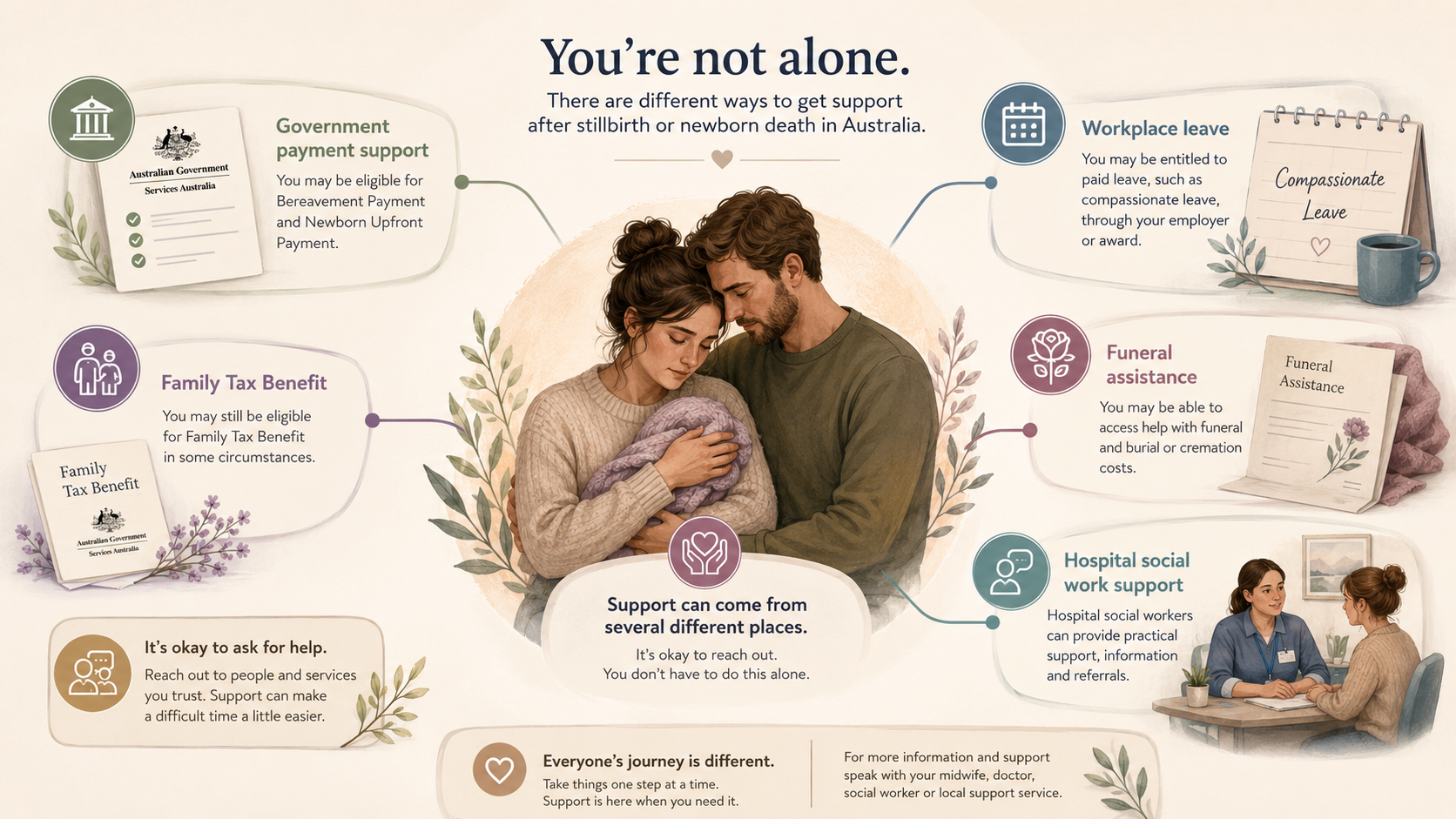
A few things to watch for
Assuming the payment is automatic. Hospital or birth records do not necessarily complete a Centrelink claim. Check the claim through myGov or contact Services Australia.
Claiming both payments for the same stillborn baby. Parental Leave Pay and Stillborn Baby Payment generally cannot be paid together for the same baby.
Using outdated payment names or amounts. Older articles may describe payments that no longer operate. Check current figures on the Services Australia website.
Missing the claim deadline. Stillborn Baby Payment generally needs to be claimed within 52 weeks of the baby’s birth, subject to limited extensions.
Confusing taxable and tax-free payments. Parental Leave Pay is taxable. Stillborn Baby Payment is tax free.
Assuming the reserved-days rule still applies. Following stillbirth or neonatal death, one eligible parent may be exempt from sharing reserved days and may be able to claim all available days.
Assuming workplace leave ends after the loss. Eligible unpaid parental leave may continue. The employer generally cannot simply direct the employee to return early.
How to check
Before making a claim, confirm whether Services Australia will assess the situation as a stillbirth or as the death of a child who was born alive.
Have the following information available where possible:
- Proof of birth or hospital birth confirmation
- Gestational age and birth weight where relevant
- The baby’s date of birth and date of death
- The claimant’s Centrelink Customer Reference Number
- A myGov account linked to Centrelink
- Work dates and hours for the Parental Leave Pay work test
- Individual and family income details
- Visa and residence information
- Details of any existing Family Tax Benefit or Parenting Payment claim
- The employer’s leave policy or enterprise agreement
When speaking with Services Australia, ask:
- Do I need to choose between Parental Leave Pay and Stillborn Baby Payment?
- Can one parent claim all Parental Leave Pay days under the reserved-days exemption?
- Can my partner and I receive days at the same time?
- Am I eligible for an FTB bereavement payment?
- Can Parenting Payment continue temporarily?
- Can Newborn Upfront Payment or Newborn Supplement apply?
- What documents are still required?
- What is the claim deadline?
- Is the payment taxable?
- Could it affect another Centrelink payment?
Claims can normally be started through a Centrelink online account linked to myGov.
People who cannot claim online may be able to use the Claim and Notes for Bereavement Payment form.
For workplace questions, search the employment documents for terms such as “parental leave”, “stillbirth”, “infant death”, “compassionate leave”, “bereavement leave” and “employer-funded paid parental leave”.
If the employer’s response does not appear consistent with the National Employment Standards or workplace policy, contact the Fair Work Ombudsman.
Emotional and practical support
Financial information does not address the grief itself, and families do not need to manage the process alone.
A hospital social worker, bereavement midwife, GP or maternity team may help with claims, certificates, funeral arrangements and referrals.
Red Nose Grief and Loss provides support for people affected by miscarriage, stillbirth, neonatal death and the death of a child.
If someone is in immediate danger or at risk of harm, call Triple Zero on 000. Lifeline is available on 13 11 14.
The bottom line
Financial support after stillbirth or newborn death depends on whether the baby was stillborn or born alive and which eligibility rules the family meets.
For a stillbirth, the main decision is usually between Parental Leave Pay and the one-off, tax-free Stillborn Baby Payment. Both require a claim, and they generally cannot be paid together for the same baby.
Following stillbirth or neonatal death, one eligible parent may be exempt from the usual reserved-days rule and may be able to claim all available Parental Leave Pay days. Parents can still choose to share the payment if both are eligible.
When a baby was born alive and later died, Parental Leave Pay may continue, and Family Tax Benefit bereavement payments may also apply. Parenting Payment may continue temporarily in some circumstances.
Workplace leave is separate. Eligible employees may retain unpaid parental leave and may also have employer-funded paid leave protected under the Fair Work rules.
Start with Services Australia, but also speak with the employer and hospital social worker. Payment rates, income limits and leave rules can change, so check the linked official pages before deciding which claim or leave arrangement best fits the family’s circumstances.
Sources
- Services Australia — Experiencing stillbirth or neonatal death
- Services Australia — Stillborn Baby Payment eligibility
- Services Australia — Parental Leave Pay eligibility
- Services Australia — Choosing between Stillborn Baby Payment and Parental Leave Pay
- Services Australia — Family Tax Benefit when a child has died
- Fair Work Ombudsman — Stillbirth, premature birth or death of a child
- Fair Work Ombudsman — Baby Priya’s Law
- Pregnancy, Birth and Baby — What is a stillbirth?