Can Your Family Really Pay Around $12 a Day for Childcare? Understanding the CCS 90% Subsidy
Some Australian families may pay around $12 a day for childcare, but only in specific circumstances. Learn how the 90% Child Care Subsidy works, including income thresholds, hourly caps, withholding, and gap fees.

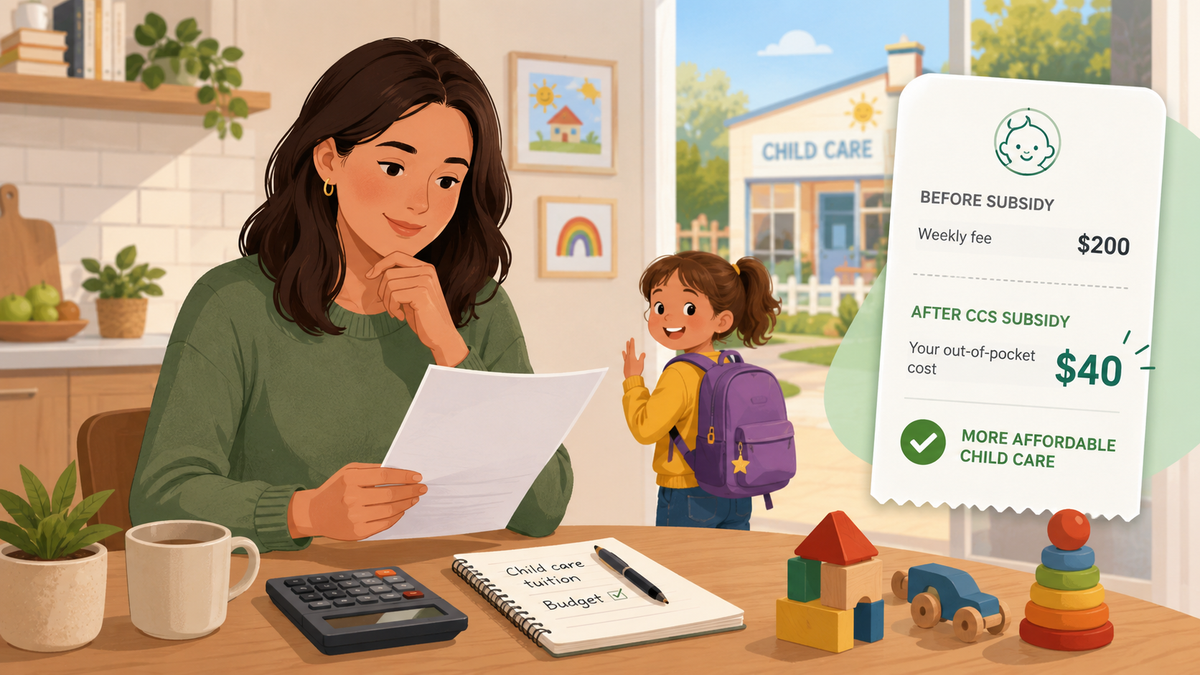
If you've ever looked at your childcare invoice and thought “this can't be right,” you're not alone. The Child Care Subsidy system in Australia is genuinely confusing. There are income thresholds, hourly caps, withholding amounts, and activity rules all layered on top of each other.
I had the same question when I first heard someone say they were only paying around $12 a day for childcare. It sounded too good to be true.
So today, I want to answer one specific question: if your household income qualifies for the maximum 90% Child Care Subsidy, how much could you realistically be paying out of pocket each day for approved childcare in Australia?
This article is mainly for families using or planning to use approved Centre Based Day Care, often called long day care. If you use Family Day Care or Outside School Hours Care, the numbers are slightly different, but the same general rules apply.
Short answer first
Yes, some families can end up paying around $12 a day for childcare, but only in specific circumstances.
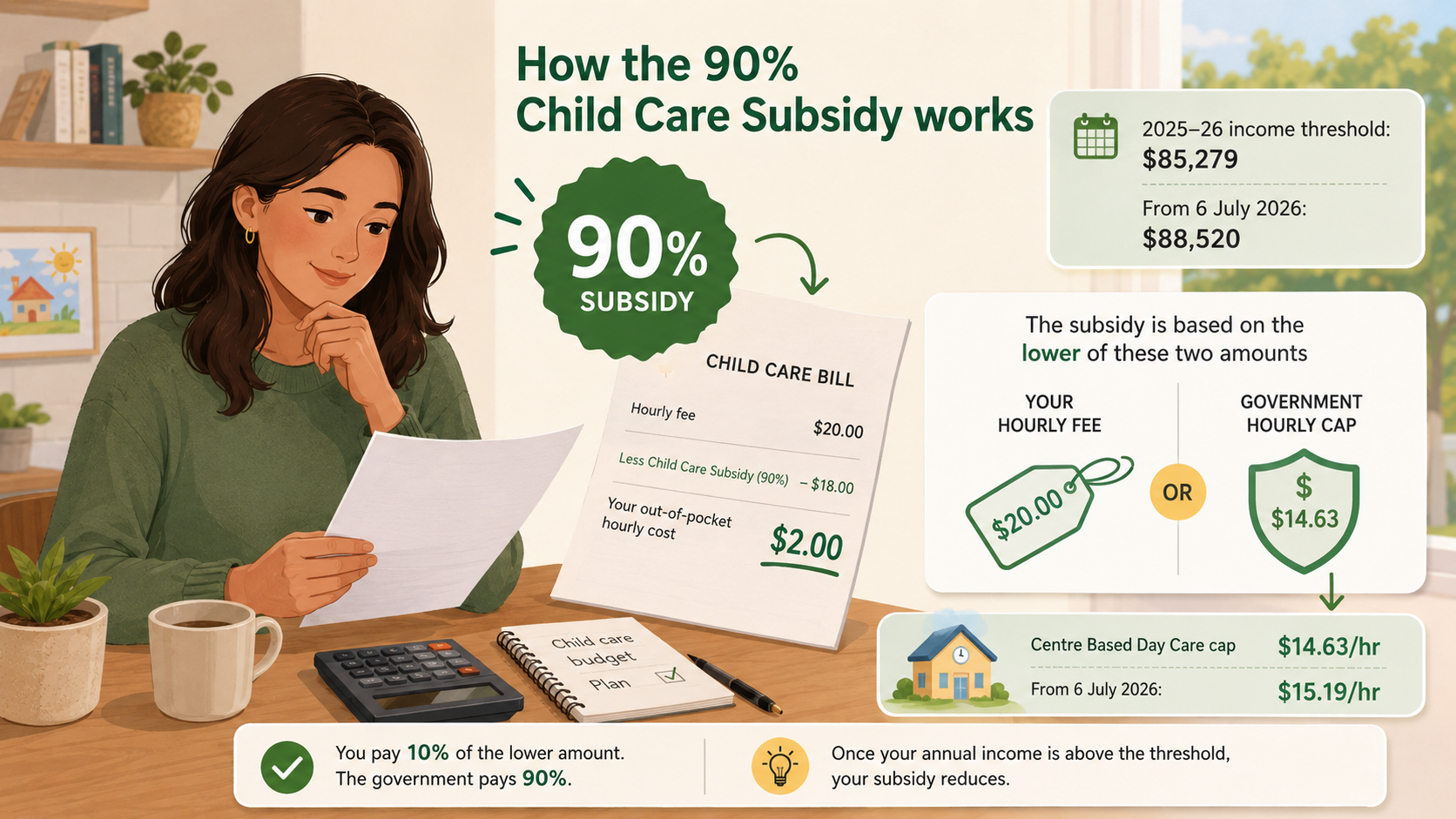
For the 2025–26 financial year, families with combined adjusted taxable income up to $85,279 may be eligible for the maximum Child Care Subsidy rate of 90%. From 6 July 2026, for the 2026–27 CCS year, this threshold rises to $88,520.
However, the 90% subsidy does not simply apply to any fee your childcare centre charges. CCS applies to the lower of two amounts:
- your provider’s actual hourly fee, or
- the government’s CCS hourly rate cap.
For 2025–26, the Centre Based Day Care hourly rate cap for children below school age is $14.63 per hour. From 6 July 2026, for 2026–27, this cap rises to $15.19 per hour.
So if your centre’s fee is under the cap, the 90% subsidy can apply to the full hourly fee. But if your centre charges above the cap, CCS only applies up to the cap, and you pay the extra amount yourself.
In practice, the 5% CCS withholding means your invoice may show around $18 to $19 instead of around $12 to $13 during the year. This withheld amount is reconciled after the financial year when Services Australia balances your CCS against your confirmed income. If your income estimate was accurate and you do not have a CCS debt, you may receive the withheld amount back after balancing.
The “around $12 a day” figure should be treated as an example only, not a guaranteed daily price. Your actual gap fee depends on your provider’s hourly fee, session length, CCS percentage, withholding, and whether your fee is above the CCS hourly rate cap.
For the latest official figures, check the Services Australia CCS income page and the Department of Education’s CCS hourly rate caps update.
How the 90% Child Care Subsidy works
Child Care Subsidy, or CCS, is the main Australian Government payment that helps eligible families with the cost of approved childcare for children aged 13 and under.
It is administered by Services Australia through Centrelink, with policy set by the Department of Education. The payment does not usually go into your bank account. Instead, it is paid directly to your childcare provider, and you pay the remaining amount. That remaining amount is often called the gap fee.
For 2025–26, families with combined adjusted taxable income of $85,279 or less may receive the maximum standard CCS rate of 90%. From 6 July 2026, the 2026–27 threshold increases to $88,520.
If your family income is above the lower threshold, your CCS percentage gradually reduces. It is not a sudden cliff. For every $5,000 of income above the lower threshold, the subsidy rate reduces by 1 percentage point until it reaches zero at the upper income limit.
It is also important to understand what “family income” means. CCS uses your combined adjusted taxable income, not just your weekly wage or salary. Adjusted taxable income can include income from employment, business, investments, rental income, reportable fringe benefits, and other amounts. If you have a partner, both incomes are counted together.
To receive CCS, you also need to meet general eligibility rules. These include residence requirements, your child’s immunisation status, and whether the childcare service is approved. You also need to lodge a CCS claim through myGov and Centrelink. CCS is not automatic just because your income is under the threshold.
You can read the official overview on the Services Australia Child Care Subsidy page. If you need to apply, follow the official steps on How to claim Child Care Subsidy.
There may be limits on how far back CCS can apply, so it is safer to claim as early as possible once you know you need childcare.
Where the “around $12 a day” example comes from
The “around $12 a day” figure usually comes from a simple example where the childcare fee is low enough to sit under the hourly rate cap.
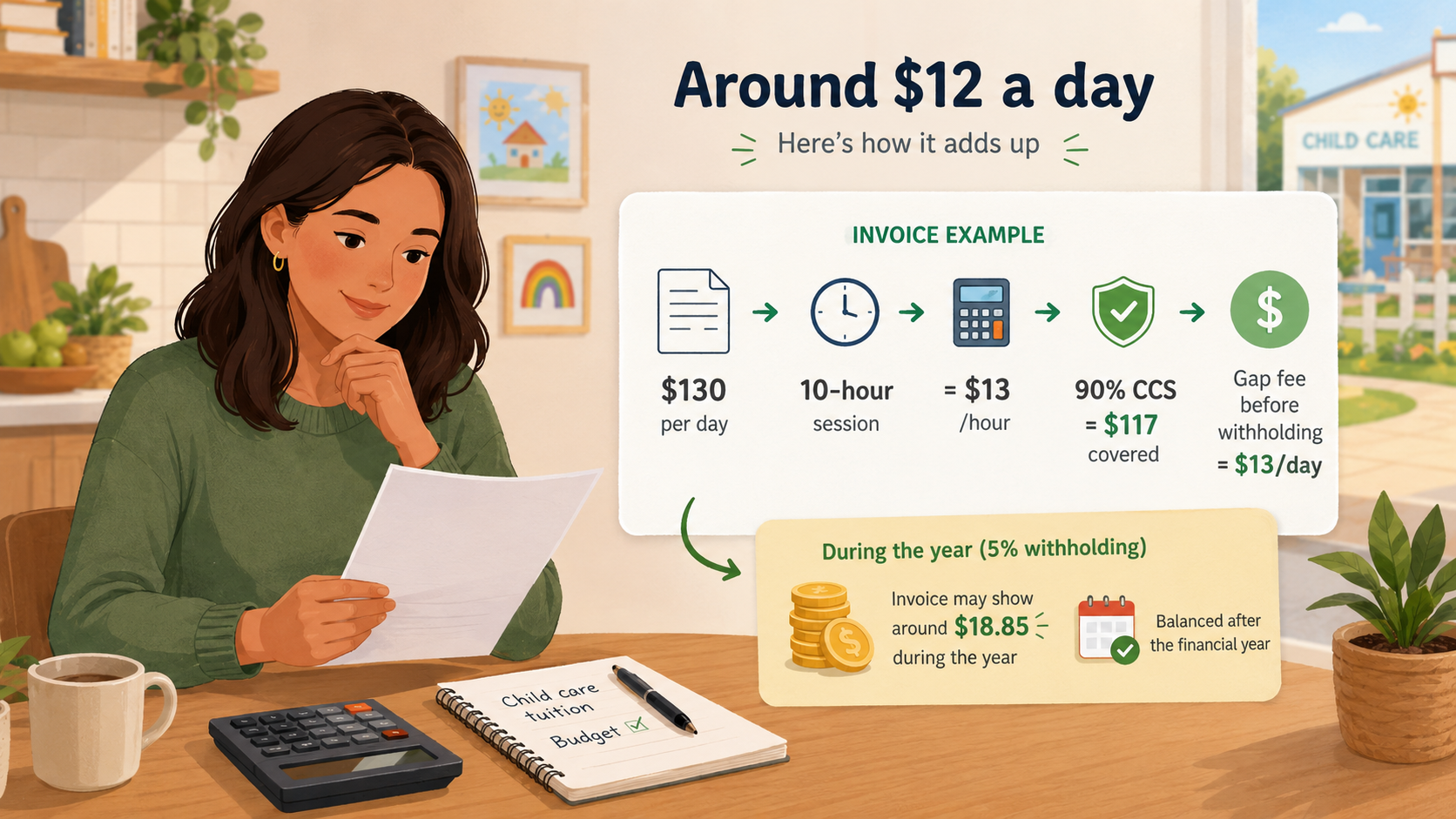
For example, if your centre charges $130 for a 10-hour day, that’s $13 per hour.
For 2025–26, the Centre Based Day Care hourly rate cap is $14.63 per hour, so this example sits below the cap. You can compare your provider’s fee with the official cap on the Department of Education’s CCS hourly rate caps update.
For 2025–26, the Centre Based Day Care hourly rate cap is $14.63 per hour. Because $13 per hour is below the cap, CCS can be calculated on the full $13 hourly fee.
At 90% CCS, the government covers $11.70 per hour. That means your gap is $1.30 per hour, or $13 for the day before withholding.
That is why some people talk about childcare costing around $12 or $13 a day.
But this is only a simplified calculation.
In practice, the 5% CCS withholding means your invoice may show around $18.85 instead of $13 during the year. This withheld amount is reconciled after the financial year when Services Australia balances your payments against your confirmed income. If your income estimate was accurate and you do not have a CCS debt, you may receive the withheld amount back after balancing.
The other major factor is the hourly cap. If your childcare centre charges above the cap, CCS only subsidises up to the capped amount.
For example, if your centre charges $16 per hour in 2025–26, CCS does not cover 90% of $16. It covers 90% of $14.63. You pay the remaining 10% of the capped amount, plus the full amount above the cap.
This is why two families with the same income and the same CCS percentage can still pay different gap fees.
The 5% CCS withholding you might not know about
Many families only notice the 5% withholding once they look closely at their childcare invoice.
By default, Services Australia withholds 5% of your CCS entitlement during the financial year. This is designed to reduce the risk of overpayment if your actual income ends up higher than your estimate.
Using the earlier example, if your full CCS entitlement for the day is $117, Services Australia may only pay 95% of that amount to your childcare provider during the year. That would be about $111.15 instead of the full $117.
This means your daily gap fee could show as around $18.85 instead of $13.
After the financial year ends, Services Australia balances your CCS. They compare your estimated income with your confirmed income, usually after you lodge your tax return. If your estimate was accurate and you do not owe money, you may receive the withheld amount back. If your income was higher than expected, the withheld amount may help reduce any debt.
Some families can adjust their CCS withholding percentage through myGov.
You can check the official withholding explanation on the Services Australia income and CCS page, and read more about end-of-year balancing on Balancing Child Care Subsidy.
However, lowering your withholding may increase the risk of a debt later if your income estimate is too low. If your income changes during the year, it is important to update your estimate as soon as possible.
So when can you get the full 90%?
You may be eligible for the maximum 90% CCS rate if several conditions line up.
First, your family income needs to qualify for the maximum CCS rate. For 2025–26, that means combined adjusted taxable income of $85,279 or less. From 6 July 2026, the threshold increases to $88,520 for 2026–27.
Second, your child must be attending an approved childcare service, and your CCS claim needs to be active through myGov and Centrelink.
Third, you need to meet the general CCS eligibility rules, including residence and immunisation requirements.
From 5 January 2026, the 3 Day Guarantee means CCS-eligible families can get at least 72 hours of subsidised care per fortnight, even if parents do not meet the previous work, study, training, or volunteering activity test.
You can confirm the current rule on the Department of Education’s official 3 Day Guarantee page.
Some families may be eligible for up to 100 hours of subsidised care per fortnight depending on work, study, training, volunteering, exemptions, Additional Child Care Subsidy, or other circumstances.
The 3 Day Guarantee is important because it gives eligible families access to a minimum amount of subsidised care. But it does not mean childcare is free, and it does not remove the hourly rate cap. Your final out-of-pocket cost still depends on your CCS percentage, your provider’s hourly fee, session length, withholding, and whether your fee is above the cap.
When can you get close to $12 a day?
You are more likely to see a gap fee around $12 to $20 per day if several conditions line up.
First, your family income qualifies for the maximum CCS rate.
Second, your childcare provider’s hourly fee is at or below the CCS hourly rate cap. For Centre Based Day Care, the cap is $14.63 per hour in 2025–26 and $15.19 per hour from 6 July 2026.
Third, your session length matters. A $130 daily fee over 10 hours is $13 per hour. But a $150 daily fee over 10 hours is $15 per hour, which is above the 2025–26 cap.
Fourth, the 5% withholding can make your actual invoice look higher than the simple calculation. Even if the maths says your gap fee is $13 per day before withholding, your invoice may show a higher amount during the year.
Finally, you need to have an active CCS claim. If you have not applied through myGov and Centrelink, the subsidy will not be applied to your childcare fees.
Here's the difference at a glance
CCS maximum rate
Who runs it:
Australian Government through Services Australia.
Maximum rate:
90% for eligible families in the lowest income bracket.
Income threshold:
For 2025–26, the maximum 90% rate applies to families with combined adjusted taxable income up to $85,279. From 6 July 2026, for 2026–27, this threshold rises to $88,520.
Hourly cap:
For Centre Based Day Care for children below school age, the 2025–26 hourly rate cap is $14.63. From 6 July 2026, the 2026–27 cap rises to $15.19.
Automatic or not:
Not automatic. You must claim CCS through myGov and Centrelink.
How it is paid:
Paid directly to your approved childcare provider.
5% CCS withholding
Who applies it:
Services Australia.
Amount:
Usually 5% of your CCS entitlement by default.
Purpose:
To reduce the risk of overpayment if your income estimate is too low.
How it affects your invoice:
Your weekly or fortnightly gap fee may look slightly higher during the year.
What happens later:
The withheld amount is reconciled after the financial year when Services Australia balances your CCS against your confirmed income.
A few things to watch for
1. Assuming CCS is automatic
CCS is not automatically applied just because your income is under the threshold. You need to submit a claim through myGov and Centrelink. Your childcare provider also needs to have your enrolment details linked correctly.
If CCS is not showing on your invoice, check your myGov account and contact your provider.
2. Using an outdated income estimate
Your CCS percentage is based on the income estimate you give to Services Australia.
If your income changes during the year, your estimate should be updated. This includes pay rises, extra shifts, a partner returning to work, business income, bonuses, or investment income.
If your estimate is too low, you may receive too much CCS during the year and end up with a debt after balancing.
3. Forgetting the hourly cap
The hourly cap is one of the main reasons families pay more than expected.
A centre may quote a daily fee, but CCS is calculated using hourly amounts. To check your hourly fee, divide the daily fee by the number of hours in the session.
For example, a $130 day over 10 hours is $13 per hour, which is under the 2025–26 Centre Based Day Care cap of $14.63.
But a $150 day over 10 hours is $15 per hour, which is above the 2025–26 cap. In that case, CCS only applies to $14.63 per hour, and you pay the rest yourself.
4. Forgetting about 5% withholding
The simple CCS calculation may not match your invoice exactly because of the default 5% withholding.
This does not usually mean your provider has made a mistake. It may simply mean part of your CCS is being held until balancing occurs after the financial year.
5. Not confirming income after the financial year
After the financial year ends, Services Australia balances your CCS using your confirmed income.
If you need to lodge a tax return, your CCS usually cannot be balanced until that is done. Delays in confirming income can delay any top-up payment or affect your CCS.
Government payments change often, so avoid relying on old social media posts or word of mouth. Always check the official site before you plan your budget.
How to check your own situation
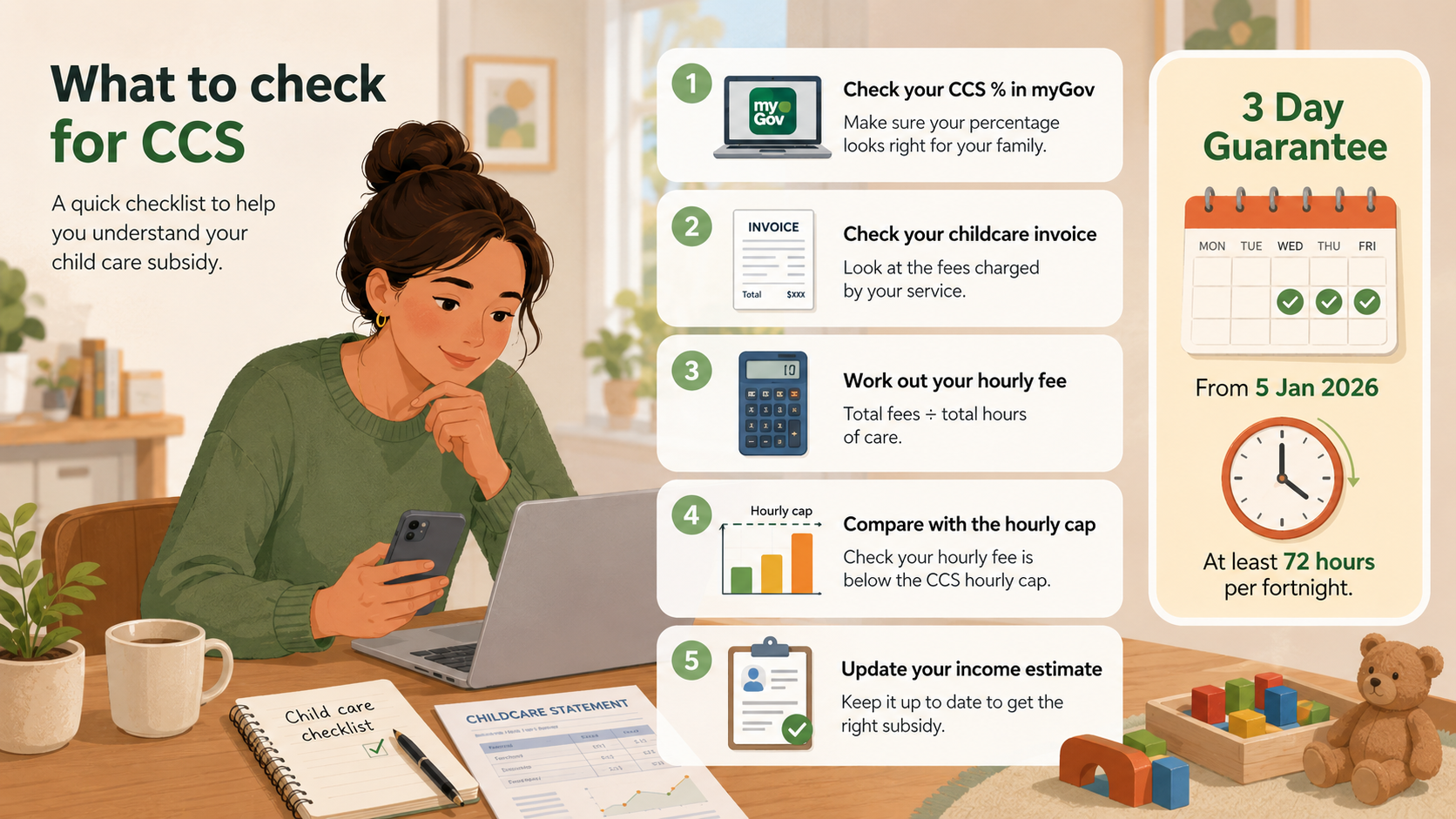
Here are the steps you can take.
For official account steps, use Services Australia’s How to manage your Child Care Subsidy page. Avoid using screenshots of your personal myGov or Centrelink account in public posts, because they may show private details.
1. Check your CCS percentage
Log into myGov and go to your linked Centrelink account. Look for your Child Care Subsidy details and check your current CCS percentage.
If it says 90%, you are receiving the maximum standard CCS rate.
2. Check your childcare invoice
Look for terms such as:
- CCS applied
- subsidy received
- gap fee
- daily fee
- hourly fee
- session length
- withholding
If CCS is not listed at all, your claim may not be active or your enrolment may not be correctly linked.
3. Work out your hourly fee
Divide your daily session fee by the number of hours charged.
For example:
$130 per day divided by 10 hours = $13 per hour.
Then compare that amount with the CCS hourly rate cap.
For 2025–26, the Centre Based Day Care cap is $14.63 per hour. From 6 July 2026, for 2026–27, it rises to $15.19 per hour.
4. Use an official calculator
You can use an official CCS calculator or estimator to get a more realistic idea of your likely gap fee.
Make sure you enter your income estimate, childcare fee, session length, and number of days accurately.
5. Contact Services Australia or your provider
If something looks wrong, contact your childcare provider first to check your enrolment and invoice details.
If your CCS percentage or income estimate looks wrong, contact Services Australia through your Centrelink account or the Families line.
The bottom line
For the 2025–26 financial year, families with combined adjusted taxable income up to $85,279 may be eligible for the maximum 90% Child Care Subsidy. From 6 July 2026, for 2026–27, that threshold rises to $88,520.
That can bring childcare gap fees down to around $12 to $20 per day for some families, especially where the provider’s hourly fee is at or below the CCS hourly rate cap.
But the “around $12 a day” figure is only an example, not a guaranteed price.
Your actual out-of-pocket cost depends on your provider’s fee, session length, CCS percentage, hourly rate cap, 5% withholding, and whether your Centrelink details are up to date.
CCS is not automatic. You need to apply through myGov, keep your income estimate updated, and check your childcare invoice carefully.
Because income thresholds and hourly caps change each financial year, always check the official Services Australia and Department of Education websites before making financial decisions.
Sources
- Services Australia: Child Care Subsidy
- Services Australia: How much Child Care Subsidy you can get
- Services Australia: Your income can affect Child Care Subsidy
- Services Australia: Who can get Child Care Subsidy
- Services Australia: How to claim Child Care Subsidy
- Services Australia: Balancing Child Care Subsidy
- Services Australia: Your family income estimate
- Department of Education: Child Care Subsidy hourly rate caps are changing soon
- Department of Education: 3 Day Guarantee